
FD vs RD: What Is Recurring Deposit and Which Is Better?
FD vs RD compared. What is recurring deposit, RD meaning, how an RD differs from a fixed deposit, and which suits a lump sum versus a monthly saving habit.


By Arvind Kumar · Published 9 October 2026 · Updated 9 October 2026
FD vs RD comes down to one difference: how the money goes in. A fixed deposit takes a lump sum once. A recurring deposit takes a fixed amount every month for an agreed term. Both lock a rate on day one and both are taxable (RBI deposit rules, retrieved 2026-10-09). An FD suits money you already hold; an RD suits money you're saving from income. At the same rate, an FD earns more.
Key takeaways- FD takes one lump sum. RD takes a fixed amount monthly. - At the same rate and term, an FD earns more, because the money is invested for longer. - Both lock the rate on booking day, and interest on both is taxable at your slab rate (Income Tax Department, retrieved 2026-10-09). - An RD builds the saving habit. An FD puts money you already have to work.
What is recurring deposit? RD meaning explained
RD stands for Recurring Deposit. You commit to paying a fixed amount into the deposit every month for an agreed term, and the bank pays a fixed rate on the growing balance.
Definition — recurring deposit. A deposit built by equal monthly instalments over a set tenure, at a rate fixed when you open it, regulated under RBI deposit rules (retrieved 2026-10-09).
Definition — instalment. The fixed monthly amount, auto-debited from your savings account on a date you pick.
RD meaning in bank terms is simply disciplined saving with a guaranteed rate. You're not investing a pile of money; you're committing to build one, usually by standing instruction from your savings account.
FD vs RD: the full comparison
| Fixed deposit (FD) | Recurring deposit (RD) | |
|---|---|---|
| How you pay in | One lump sum | Fixed amount every month |
| Who it suits | Someone who already has the money | Someone saving from salary |
| Rate | Fixed on booking day | Fixed on opening day |
| Total interest earned | Higher for the same rate and term | Lower, since later instalments earn for less time |
| Missing a payment | Not applicable | Penalty, and repeated misses can close the account |
| Premature withdrawal | Allowed, with penalty | Allowed, with penalty |
| Interest taxable | Yes | Yes |
Total interest is the row that matters most is total interest. Money paid in month eleven of a twelve-month RD earns one month of interest. In an FD, every rupee earns for the whole term. Same rate, different outcome, and neither product is being unfair about it.
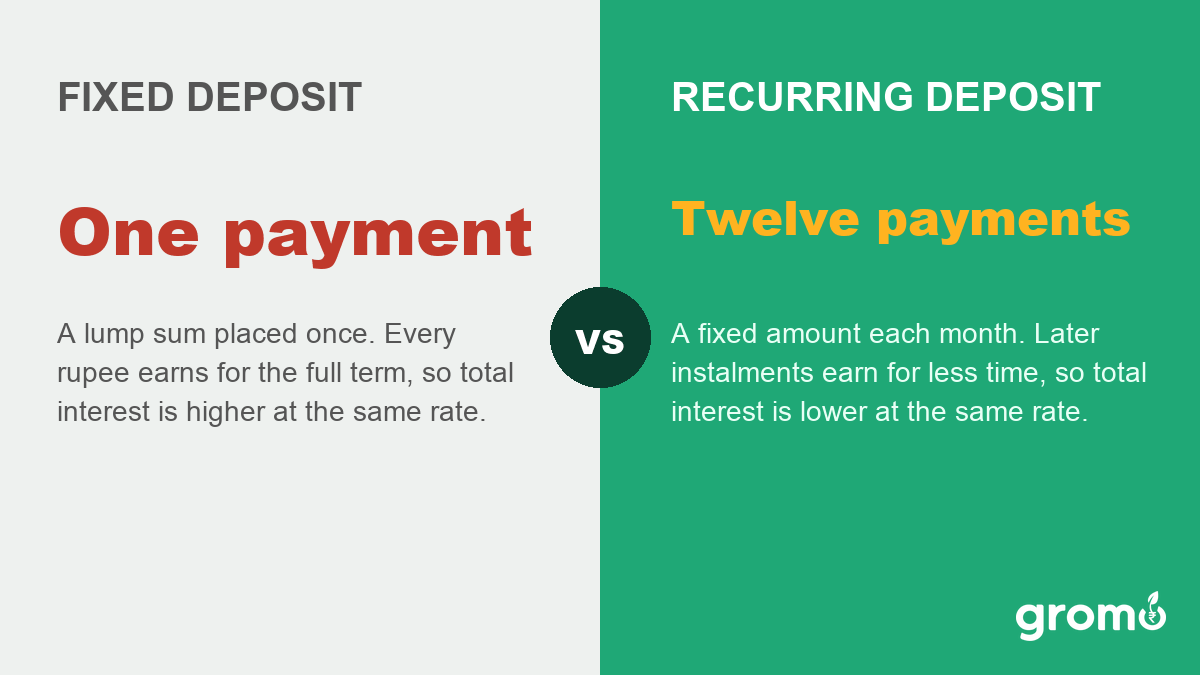
One payment or twelve. Image: GroMo.
Which earns more, FD or RD?
An FD, if you're comparing like with like. The rates offered are often similar, so the difference comes entirely from how long each rupee stays invested.
A worked way to see it, using arithmetic rather than a projection: put twelve thousand into a one-year FD and the whole twelve thousand earns for twelve months. Pay one thousand a month into a one-year RD and you've also paid in twelve thousand, but the average rupee has been invested for roughly half the time. The FD therefore earns close to twice the interest at the same rate.
None of that is an argument against RDs. If you don't have twelve thousand today, the FD isn't an option at all, and an RD earning something beats a plan you can't start.
When should I choose an RD instead?
You're saving from monthly income. The auto-debit does the work, and the commitment is the point.
You want a target date. School fees, a trip, an insurance premium falling due.
You struggle to keep savings untouched. Money sitting in an ordinary account is a lot easier to spend than money inside a deposit.
You're building a first emergency buffer. Start an RD, then roll the maturity into an FD.
Rolling an RD into an FD is worth knowing. Many people run an RD to accumulate, then convert the maturity amount into an FD so it keeps earning at the higher effective rate.
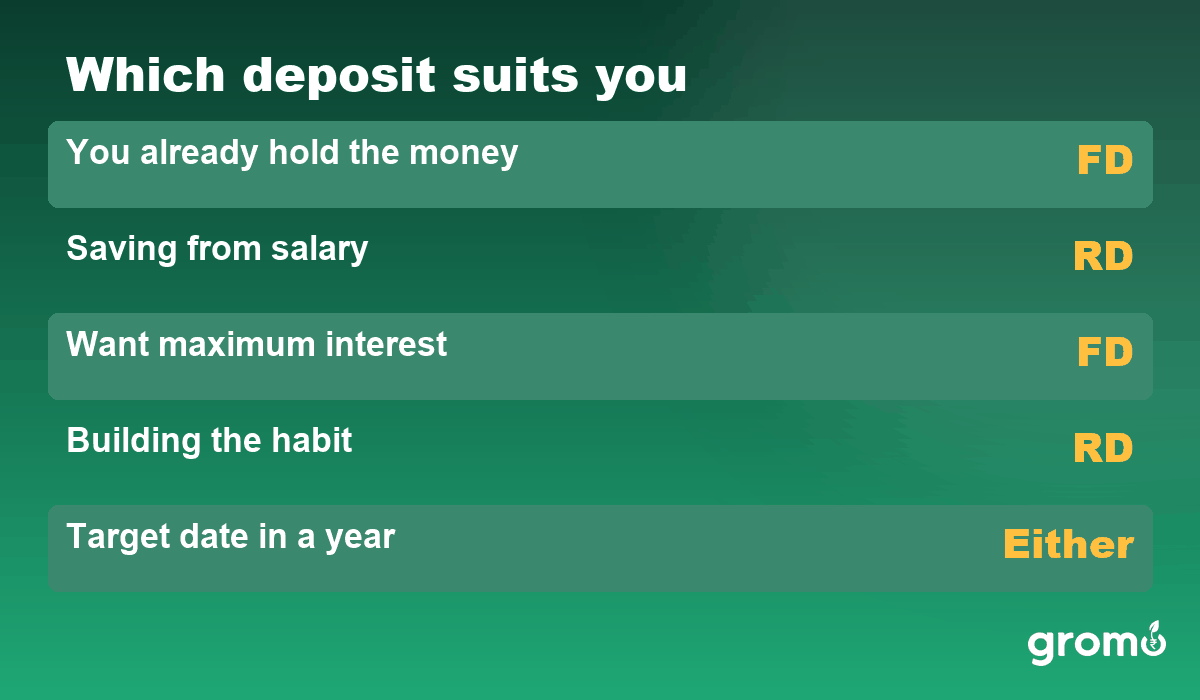
Where the money comes from decides it. Image: GroMo.
What happens if I miss an RD instalment?
The bank charges a small penalty for the missed month, and the maturity amount reduces accordingly.
Miss several in a row and some banks close the account early, paying out whatever has accrued. Policies differ, so check yours before assuming a grace period exists.
Two habits prevent it. Set the debit date just after your salary date. And keep a small buffer in the linked account, because an RD debit that bounces may also attract a separate charge on the savings account.
Is RD interest taxable?
Yes, the same as a fixed deposit. Interest is added to your income and taxed at your slab rate, and the bank deducts TDS once interest from that bank crosses the annual threshold for the year (Income Tax Department, retrieved 2026-10-09).
Form 15G, or 15H for senior citizens, tells the bank not to deduct when your total income is below the taxable limit. Submit it at the start of the financial year.
Referring deposit products with GroMo
GroMo is an Indian financial-products distribution platform where individuals refer products from partner banks, NBFCs and fund houses and earn a commission on approved referrals.
Deposit products sit alongside cards and loans in the catalogue (GroMo product catalogue, retrieved 2026-10-09):
| Product | Commission per approved referral |
|---|---|
| Jiraaf Bond investment | ₹250 |
| BharatPe Fixed Deposit | ₹100 |
| Stable Money (FD) | ₹100 |
| BharatPe Digital Gold | ₹100 |
Rates are campaign-linked and change without notice. Deposits suit a different conversation from cards: the customer isn't borrowing, so the question is where idle or monthly money should sit. For the wider range, investment products covers the alternatives.
Frequently asked questions
Below are the questions people most often ask alongside this one.
What is recurring deposit in simple words?
A recurring deposit is a savings product where you pay a fixed amount every month for an agreed term, and the bank pays a fixed rate on the balance as it builds.
What is RD meaning in bank?
RD means Recurring Deposit. In a bank, it's an account you feed monthly by standing instruction, maturing into a lump sum at the end of the term.
Which is better, FD or RD?
Neither is better in general. An FD suits money you already hold; an RD suits money you're saving month by month. For the same rate and term, an FD earns more total interest.
Can I withdraw an RD before maturity?
Usually yes, with a penalty and a reworked rate for the period actually served. The exact terms vary by bank.
Where the money comes from decides it. Image: GroMo.
What happens if I miss an RD instalment?
The bank levies a small penalty and the maturity amount falls. Repeated misses can lead some banks to close the account early.
Is RD interest taxable?
Yes. It's added to your income and taxed at your slab rate, with TDS deducted once interest from that bank passes the annual threshold.
Can I open both an FD and an RD?
Yes. Running an RD to accumulate and moving the maturity into an FD is a common and sensible pattern, and how to open a savings account covers the account both need.
Summary
FD vs RD is a question of how the money arrives. A fixed deposit takes one lump sum; a recurring deposit takes a fixed amount monthly. Both fix the rate on day one and both are taxable. An FD earns more for the same rate and term because every rupee is invested longer, but an RD is the only option if you're saving out of income rather than deploying a sum you already hold.
Disclosures
GroMo (Vitrak Technologies Pvt Ltd) is a distribution platform. GroMo is not a bank, NBFC, insurer or investment adviser. All products are offered by their respective RBI, IRDAI or SEBI-regulated providers.
Partner earnings depend on effort, product mix and customer eligibility. Any figures shown are illustrative examples of individual results. They are not typical and are not guaranteed. GroMo does not guarantee any level of income.
Rates, penalties, tenures and tax thresholds are set by individual banks and by prevailing tax law, and change from time to time. This article is general information, not investment or tax advice. Check current terms with the bank before deciding.
Written by Arvind Kumar. Published 9 October 2026. Last updated 9 October 2026.
Sources
- Reserve Bank of India, deposit regulation framework. Retrieved 9 October 2026. https://www.rbi.org.in/
- GroMo product catalogue, commission rates by product. Retrieved 9 October 2026.


