
Balance Transfer Credit Card: How It Works, Benefits, Fees & Eligibility
What a balance transfer credit card is, how it works in India, real fees, eligibility, no-fee offers, and how to pick the best one for your debt.

Credit card interest is among the costliest debt in India: most cards charge around 3 to 3.6 percent per month, which works out to 36 to 42 percent a year. If you are carrying an unpaid balance, a balance transfer credit card can move that debt to a new card at a much lower promotional interest rate, sometimes even 0 percent for a limited period. Used correctly, it buys you cheaper time to clear the debt.
Used carelessly, it just shifts the problem. This guide explains how a balance transfer credit card works, the real fees involved, eligibility, how to pick the best balance transfer credit card, and whether a balance transfer credit card no fee offer actually exists.
Balance Transfer Credit Card: Quick Facts
| Question | Answer |
|---|---|
| What it is | Moving unpaid dues from one credit card to another card at a lower interest rate |
| Typical promotional rate | 0% to about 1.7% per month for a fixed window, versus 3 to 3.6% normally |
| Promotional window in India | Usually 60 to 180 days, unlike the 12 to 18 months common abroad |
| Processing fee | Usually 1% to 3% of the transferred amount (plus GST); some offers waive it |
| How much you can transfer | Commonly up to about 75% of the new card's credit limit |
| Who can apply | Cardholders with a good repayment record, usually transferring from another bank's card |
| Time taken | Around a week on an existing card; longer if a new card must be issued first |
What Is a Balance Transfer Credit Card?
A balance transfer credit card is a card that lets you shift the outstanding balance of another credit card onto it, usually at a special low interest rate for a fixed period. In effect, the new bank pays off your dues to the old bank, and you now owe the new bank instead, at a cheaper rate for the promotional window.
The point is simple: your debt does not reduce, but the interest meter on it slows down or pauses. Every rupee you pay during the promotional window bites into the actual debt instead of feeding interest, which is why balance transfers are one of the standard tools for getting out of credit card debt.
How a Balance Transfer Credit Card Works
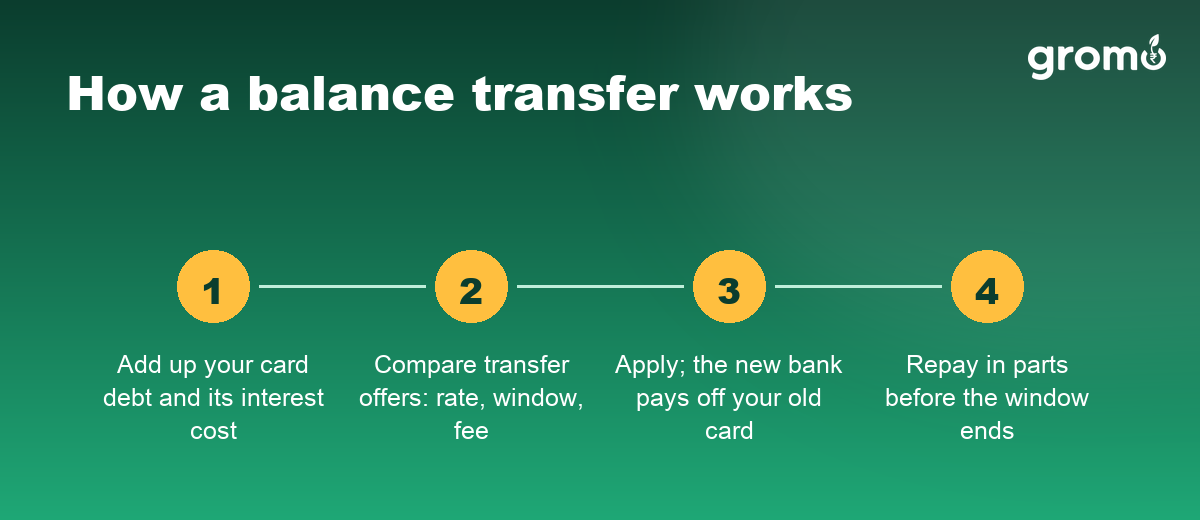
- Add up your card debt. Note the total outstanding, the interest rate on each card, and the minimum dues. This tells you how much you need to transfer and what it is costing you today.
- Pick the transfer card and offer. Compare promotional rate, promotional period, processing fee, and how much of the limit you can use. The transfer card is usually from a different bank than the card you owe on.
- Apply for the balance transfer. If you already hold a card with the new bank, you can often request the transfer through the app or customer care. Otherwise you apply for the card and request the transfer once it is issued.
- The new bank pays off the old card. The bank pays the amount to your old card, usually by draft or direct transfer, and adds that amount to your new card's outstanding at the promotional rate.
- Repay before the promotional window ends. Split the transferred amount by the number of promotional months and pay at least that much every month. Whatever remains after the window is charged at the card's normal rate again.
How Much Can You Actually Save?
Take a realistic example. Suppose you owe Rs 1,00,000 on a card charging 3.5 percent per month, and you can repay the full amount over the next 6 months.
| Scenario | Interest cost over 6 months (approx.) |
|---|---|
| Stay on the old card at 3.5% per month | Rs 12,000 to Rs 13,000 |
| Transfer at 0% for 6 months with a 2% fee | Rs 2,000 fee plus GST |
| Transfer at 1.7% per month with no fee | Rs 5,500 to Rs 6,000 |
In both transfer scenarios you save thousands, but notice the fine print: the fee, the rate, and the window length decide which offer is actually cheaper for your situation. Always do this simple math before transferring.
Benefits of a Balance Transfer Credit Card
- Lower interest cost. The gap between 3.5 percent and 0 to 1.7 percent per month is enormous on large balances.
- One debt instead of many. Dues from multiple cards can be consolidated onto one card with one due date, which makes repayment easier to manage.
- Breathing room. The promotional window gives you a defined, cheaper period to clear the debt, which is especially useful if money is expected soon, like a bonus or a client payment.
- Credit score protection. Clearing dues faster reduces your credit utilisation, and lowering utilisation is one of the fastest ways to improve your credit score.
Fees and Charges to Check
| Charge | What to expect |
|---|---|
| Processing fee | Usually 1% to 3% of the transferred amount, sometimes a flat amount; GST applies |
| Promotional interest | 0% to about 1.7% per month during the window, depending on the offer chosen |
| Post-window interest | The card's normal rate, typically 3 to 3.6% per month, on whatever is left |
| Interest on new purchases | Fresh spends usually do not get the promotional rate and may lose the interest-free period while a balance is running |
| Late payment fee | Charged as usual if you miss the minimum due; can also cancel the promotional offer |
Balance Transfer Credit Card No Fee: Does It Exist?
Yes, but read the terms carefully. Banks periodically run no-processing-fee balance transfer offers, and some structure their offers as a choice: a 0 percent interest option with a small processing fee, or a low-interest option (around 1.7 percent per month) with no processing fee.
So "no fee" usually means no processing fee, not free money; the bank earns through the interest option instead.
When you see a no-fee offer, check three things: the interest rate during the window, the length of the window, and what rate applies after it ends. A no-fee offer with a short window can cost more than a 2 percent fee offer with 0 percent interest for longer, depending on how fast you can repay.
The savings table above is the way to compare them.
Best Balance Transfer Credit Card: How to Choose
There is no single best balance transfer credit card for everyone; the best one is the offer that costs you least for your repayment speed. In India, several major issuers, including SBI Card, Axis Bank, Kotak, and IndusInd Bank, have offered balance transfer facilities; availability and terms change, so always check the bank's current offer page.
Compare on these five points:
- Promotional rate: 0% beats any other rate if the fees are comparable.
- Window length: a 180-day window is far more useful than 60 days for larger debts.
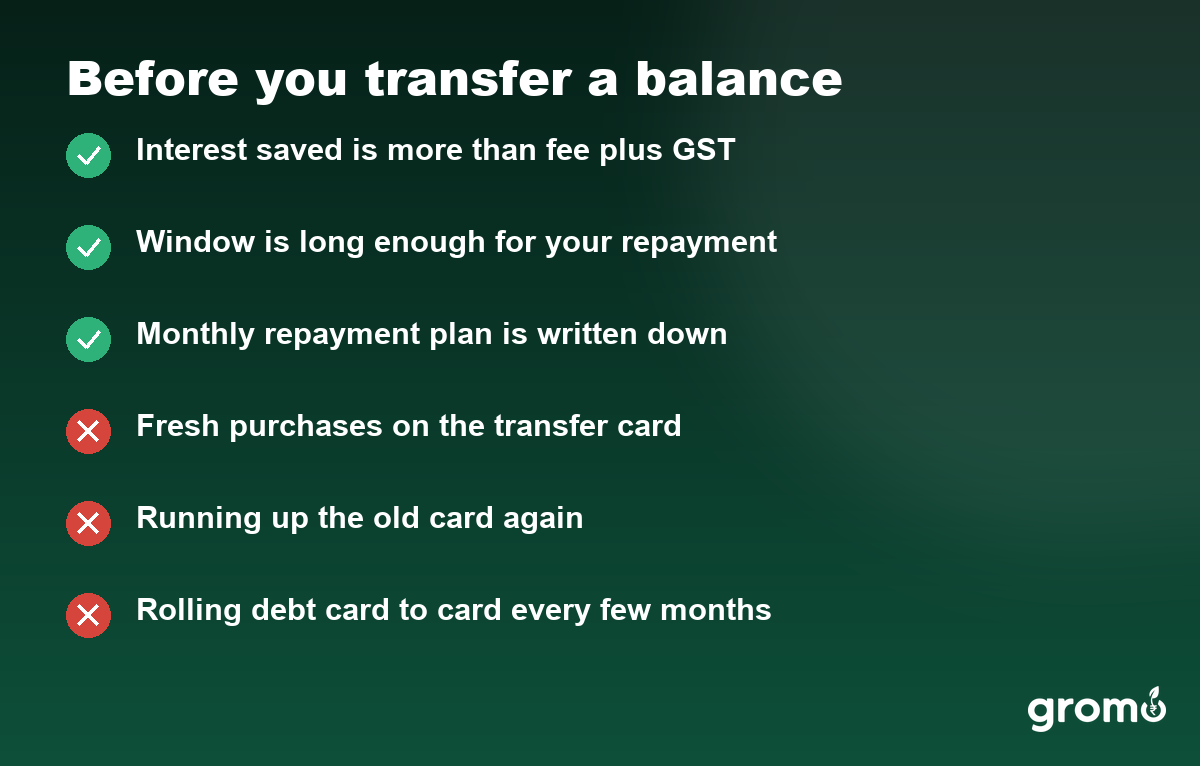
- Processing fee: compare the fee plus GST against the interest saved.
- Transfer limit: the card's limit must cover your debt; most banks allow transfers up to about 75% of the limit.
- The card itself: annual fee, and which of the types of credit cards suits your spending after the debt is cleared.
Eligibility and Documents
Exact criteria vary by bank, but the common requirements are:
- Age 21 or above (some banks 18) with a regular income source.
- A credit card from another bank with a clean repayment record; most banks do not allow transfers between their own cards.
- A good credit score, generally 700 to 750 or above, for approval and better offers.
- Some banks ask that the card being transferred from is at least 6 to 12 months old.
- Documents for a new card application: PAN, Aadhaar or other address proof, income proof, and recent statements of the card whose balance you want to transfer.
Mistakes to Avoid With Balance Transfers
- Treating the transfer as repayment. The debt has only moved. Without a monthly repayment plan, you will be back where you started, minus the fee.
- Swiping the new card for fresh purchases. New spends usually do not enjoy the promotional rate and can start attracting interest immediately while a balance is running. Keep the transfer card for repayment only.
- Running up the old card again. The old card's limit is now free, and that is a trap. Keep it unused, or close the credit card if annual fees or temptation are a concern.
- Ignoring the end date. Whatever remains after the promotional window is charged at the full rate. Set a reminder well before the window closes.
- Serial transferring. Rolling debt from card to card every few months adds fees and hard inquiries, hurts your credit profile, and never actually reduces the debt.
Does a Balance Transfer Affect Your Credit Score?
Both ways, depending on behaviour. The new card application adds a hard inquiry, which can dip your score by a few points temporarily.
But if the transfer helps you pay dues on time and brings your credit utilisation down, your score benefits over the following months. What damages the score is the pattern to avoid anyway: repeated applications, maxed-out cards, and missed payments.
Comparing Cards Through GroMo
If your plan includes taking a new credit card, compare before you apply. The GroMo app lets you compare 30+ credit cards from different banks in one place, check eligibility by pincode and profile, and apply digitally.
Balance transfer offers are set by each bank and change frequently, so confirm the current transfer terms on the issuing bank's official page before you apply. GroMo is a distribution platform, not a bank.
FAQ: Balance Transfer Credit Card
What is a balance transfer credit card?
It is a credit card that lets you move the unpaid balance of another credit card onto it at a special low interest rate, sometimes 0 percent, for a fixed promotional period. The new bank pays off your old card, and you repay the new bank at the cheaper rate during that window.
Your debt does not reduce, but the interest on it slows down, so more of each payment clears actual debt.
Which is the best balance transfer credit card in India?
The best balance transfer credit card is the offer that costs you least for your repayment speed, not a fixed card name. Compare the promotional rate, the window length, the processing fee plus GST, and the transfer limit.
Major issuers including SBI Card, Axis Bank, Kotak, and IndusInd Bank have offered balance transfer facilities, but terms change often, so check each bank's current offer page before applying.
Is there a balance transfer credit card with no fee?
Sometimes. Banks periodically run no-processing-fee transfer offers, and some let you choose between 0 percent interest with a small fee or a low rate around 1.7 percent per month with no fee.
No fee means no processing fee, not free credit, so compare the total cost of each option: fee plus GST plus interest over your repayment period.
How much can I transfer to a balance transfer credit card?
Most banks allow transfers up to about 75 percent of the new card's credit limit, subject to a minimum amount. If your debt is larger than that, you can transfer the biggest chunk and keep repaying the rest on the old card, prioritising whichever balance carries the higher rate.
Does a credit card balance transfer affect my CIBIL score?
A new card application adds a hard inquiry, which can lower your score by a few points temporarily. After that, the effect depends on you: paying on time and bringing your credit utilisation down improves the score over the following months, while repeated transfers, maxed cards, and missed payments damage it.
What happens if I do not repay within the promotional period?
Whatever balance remains when the window closes starts attracting the card's normal interest rate, typically 3 to 3.6 percent per month. Missing minimum dues during the window can also cancel the promotional offer early.
Divide the transferred amount by the number of promotional months and pay at least that much every month.
Disclaimer
This article is general information, not financial advice. Interest rates, fees, promotional windows, transfer limits, and eligibility criteria are set by each bank, differ between offers, and change over time; figures here are indicative industry ranges at the time of writing.
The issuing bank's official terms are the only authoritative source, and card approval is always the bank's decision. A balance transfer moves debt; it does not repay it.
GroMo is a financial product distribution platform, not a bank or lender, and is available only to users aged 18 and above. Bank and card names are trademarks of their respective owners.


