
MICR Code Full Form: What Is MICR Code and Where to Find It
MICR code full form is Magnetic Ink Character Recognition. What is MICR code, the 9-digit format, MICR code meaning, and where to find it on your cheque.

By Arvind Kumar · Published 9 October 2026 · Updated 9 October 2026
MICR code full form is Magnetic Ink Character Recognition. What is MICR code in practice? It's a 9-digit number printed in magnetic ink along the bottom of every Indian cheque, used to identify the bank and branch during cheque clearing. The nine digits split into three parts: city, bank and branch. Machines read it magnetically, which is why the ink matters, and why a photocopied cheque will not clear. You'll find it on the cheque leaf itself and in your passbook.
Key takeaways- MICR code full form: Magnetic Ink Character Recognition. - The code is 9 digits: 3 city, 3 bank, 3 branch, to a standard set by the Reserve Bank of India (retrieved 2026-10-09). - Printed in magnetic ink so a machine can read it even if the cheque is marked. - MICR is for cheques. Electronic transfers use IFSC instead.
MICR code full form and what is MICR code
MICR stands for Magnetic Ink Character Recognition. Strictly, that's the name of the technology; the number printed using it is the MICR code.
Definition — MICR code. A 9-digit number identifying the bank branch on which a cheque is drawn, printed in magnetic ink for automated clearing.
Magnetic ink is used for a practical reason. A cheque passes through many hands and picks up stamps, folds and ink marks. Optical reading fails on a dirty cheque; magnetic reading doesn't, because the machine senses the iron in the ink rather than the shape on the surface. Anyone opening a savings account gets a chequebook carrying this line, used or not.
What is the MICR code format?
Nine digits, in three blocks of three.
| Digits | What they identify | Example |
|---|---|---|
| 1–3 | City, matching the PIN code's first three digits | 400 |
| 4–6 | The bank | 002 |
| 7–9 | The branch | 053 |
So 400002053 reads as a Mumbai city code, a specific bank, and one of its branches.
The city block is the useful part to recognise. Because the city block mirrors the first three digits of the PIN code (RBI standard, retrieved 2026-10-09), you can usually tell which city a cheque was issued in from the MICR line alone.
Where do I find the MICR code?
Four places, in order of reliability:
- The bottom of a cheque leaf. The MICR line runs along the base, after the cheque number.
- Your passbook. Usually printed on the first page with the branch details.
- Your bank's app or net banking, under account or branch details.
- The cheque book cover, on some banks' chequebooks.
Read it from the cheque where you can. A passbook printed years ago may show a code that changed after a branch merger.
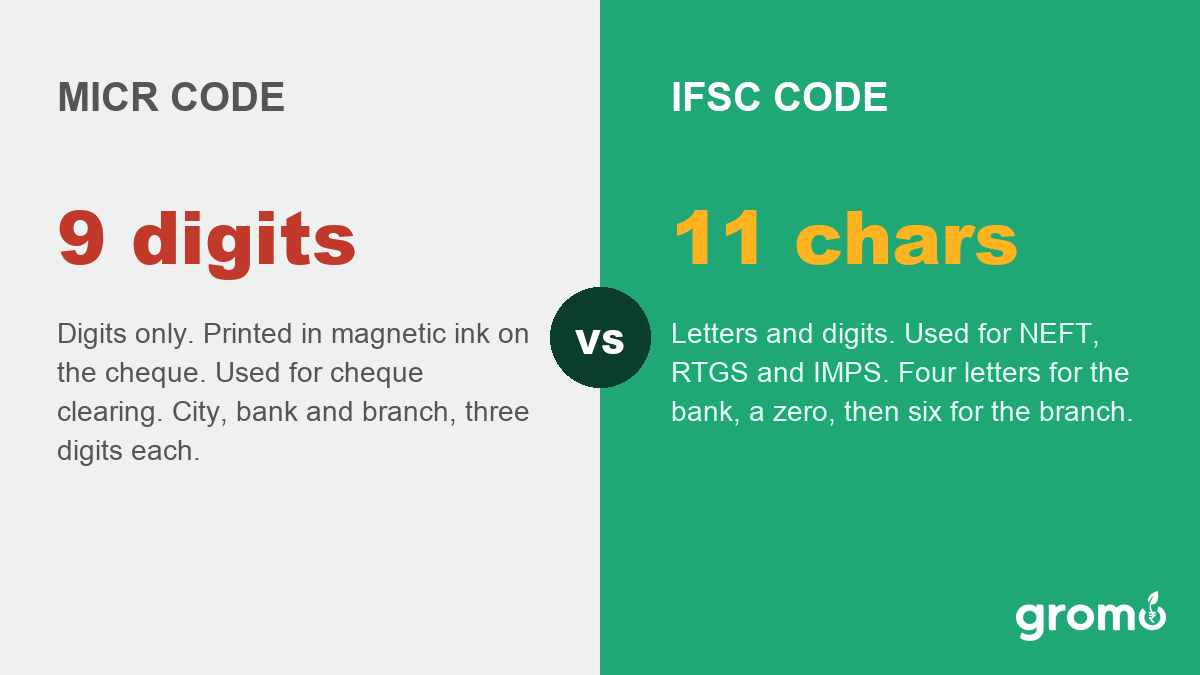
Different jobs, different codes. Image: GroMo.
MICR code vs IFSC code: what's the difference?
Both identify a branch, but they belong to different systems and look nothing alike.
| MICR code | IFSC code | |
|---|---|---|
| Length | 9 digits | 11 characters |
| Characters | Digits only | Letters and digits |
| Used for | Cheque clearing | NEFT, RTGS, IMPS |
| Printed on | Cheque leaf, in magnetic ink | Cheque leaf, normal ink |
| Needed for UPI | No | No |
A simple way to keep them apart: MICR moves paper, IFSC moves electrons. If a cheque is involved, MICR matters. If a transfer happens in an app, IFSC does.
Both are printed on the same cheque, usually within a few centimetres of each other, which is why they get confused so often.
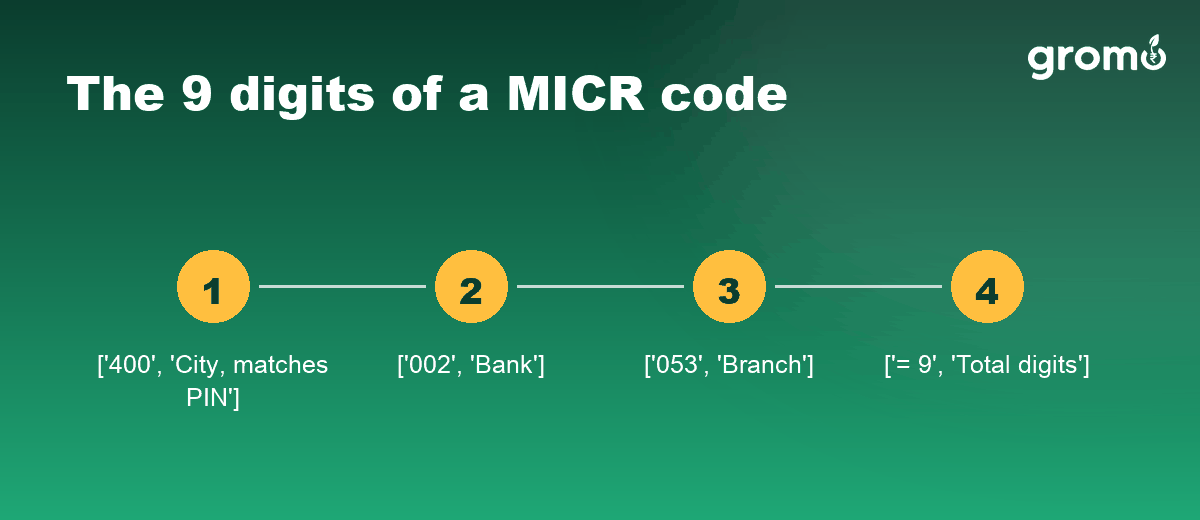
City, bank, branch. Three digits each. Image: GroMo.
Why does MICR still matter if nobody writes cheques?
Cheque volumes have fallen sharply as UPI and electronic transfers took over, but cheques haven't disappeared.
Cheques remain common for rent and security deposits, post-dated instalments on some loans, large one-off payments where the payer wants a paper record, and as a cancelled cheque submitted to verify account details for salary, refunds and mandates.
Proof of account matters most for everyday purposes. A cancelled cheque is still the standard proof of account, and the MICR line is part of what makes it verifiable. If you've never used your chequebook, this is usually why you'll eventually need it.
What happens if the MICR line is damaged?
A cheque whose MICR line is torn, heavily creased or obscured can be rejected by the clearing machine and routed for manual handling, which slows it down.
Three habits avoid it. Don't staple or pin a cheque through the bottom strip. Don't fold it along the MICR line. And don't write or stamp over the band at the base, even in the empty space.
If a cheque is returned for a MICR read failure, the usual remedy is simply issuing a fresh one. Anyone still choosing where to bank will find the options in best bank for savings accounts.
What this means if you refer banking products
GroMo is an Indian financial-products distribution platform where individuals refer products from partner banks and NBFCs and earn a commission on approved referrals.
Account-opening paperwork is where most referrals stall, and a cancelled cheque is one of the documents customers are asked for. Knowing what the MICR line is, and that it must stay legible, prevents a surprising number of rejections.
Current savings account commissions (GroMo product catalogue, retrieved 2026-10-09):
| Product | Commission per approved referral |
|---|---|
| IDFC FIRST Bank Saving Account | ₹600 |
| Kotak 811 Super Account | ₹600 |
| Equitas Selfe Savings Account | ₹250 |
Rates are campaign-linked and change without notice.
Frequently asked questions
Below are the questions people most often ask alongside this one.
What is the MICR code full form?
Magnetic Ink Character Recognition. The term names the technology; the 9-digit number printed with it is the MICR code.
What is MICR code in simple words?
A 9-digit number on the bottom of a cheque that tells the clearing system which bank and branch the cheque is drawn on.
How many digits is a MICR code?
Nine. Three identify the city, three the bank and three the branch.
Where is the MICR code on a cheque?
Along the bottom strip, printed in magnetic ink, usually after the cheque number and before the account number.
What is the difference between MICR and IFSC?
MICR is 9 digits and used for cheque clearing. IFSC is 11 characters and used for NEFT, RTGS and IMPS. Both identify a branch, in different systems.
Is MICR code the same for all branches of a bank?
No. The middle three digits identify the bank and are shared, but the last three change with every branch.
Do I need a MICR code for online transfers?
No. Online transfers use IFSC. MICR applies to cheques.
Summary
MICR code full form is Magnetic Ink Character Recognition, and the MICR code itself is the 9-digit number on the bottom of a cheque identifying city, bank and branch. Magnetic ink lets a machine read it even when the cheque is marked or folded. Use MICR for cheques and IFSC for electronic transfers, and keep the bottom strip clean so the cheque clears first time. If you're still choosing a bank, how to open a savings account covers what to compare.
Disclosures
GroMo (Vitrak Technologies Pvt Ltd) is a distribution platform. GroMo is not a bank, NBFC, insurer or investment adviser. All products are offered by their respective RBI, IRDAI or SEBI-regulated providers.
Partner earnings depend on effort, product mix and customer eligibility. Any figures shown are illustrative examples of individual results. They are not typical and are not guaranteed. GroMo does not guarantee any level of income.
Written by Arvind Kumar. Published 9 October 2026. Last updated 9 October 2026.
Sources
- Reserve Bank of India, cheque clearing and MICR standards. Retrieved 9 October 2026. https://www.rbi.org.in/
- GroMo product catalogue, commission rates by product. Retrieved 9 October 2026.


