
IFSC Code Full Form: What Is IFSC Code and How to Find It
IFSC code full form is Indian Financial System Code. What is IFSC code, the 11-character format, IFSC meaning, and how to find IFSC code for your branch.

By Arvind Kumar · Published 9 October 2026 · Updated 9 October 2026
IFSC code full form is Indian Financial System Code. What is IFSC code in practice? It is an 11-character code that identifies one specific bank branch in India's electronic payment network. Every NEFT, RTGS and IMPS transfer uses it to route money to the right branch. The format is fixed: four letters for the bank, a zero, then six characters for the branch, as in HDFC0001234. You will find yours on your cheque book, in your passbook, and inside your bank's app.
Key takeaways- IFSC is 11 characters: 4 letters (bank) + 0 (reserved) + 6 characters (branch), a format set by the Reserve Bank of India. - The fifth character is always zero, which is the quickest way to spot a typo. - You need it for NEFT, RTGS and IMPS. UPI does not need it.- Each branch has its own code, so two branches of the same bank differ.
IFSC code full form and what is IFSC code
IFSC stands for Indian Financial System Code. The Reserve Bank of India assigns one to every branch that participates in electronic fund transfers, and maintains the authoritative register of all allotted codes (RBI, retrieved 2026-10-09).
Treat it as a postal address for money. The account number says which account, and the IFSC says which branch holds it. A transfer needs both, because account numbers are only unique within a bank rather than across the country. Anyone opening their first savings account meets the code at this point.
Two people at different banks can hold the same account number without anything going wrong. The branch code is what separates them, and it's also why you can't simply guess a code from the bank's name.
What is the IFSC code format?
Every IFSC runs to exactly 11 characters, split into three fixed parts.
| Position | Characters | What it means | Example |
|---|---|---|---|
| 1–4 | Letters | The bank | HDFC |
| 5 | Always 0 | Reserved for future use | 0 |
| 6–11 | Letters or digits | The specific branch | 001234 |
Put together: HDFC0001234.
Two practical consequences. A code without a zero in the fifth position is wrong, which makes it a fast check before you send money. A code shorter or longer than 11 characters is never valid either.
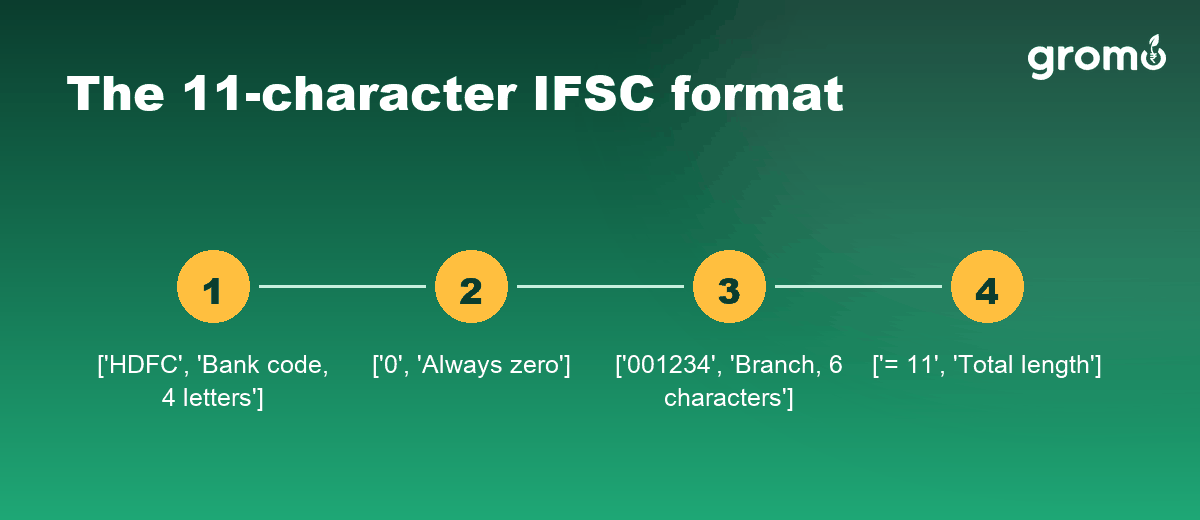
Four letters, a zero, then six characters. Image: GroMo.
How to find IFSC code for your branch
Five reliable places, in rough order of convenience:
- Your cheque book. Printed along the bottom of every leaf, next to the account number.
- Your bank's mobile app. Usually under account details.
- Your passbook. On the first page with the branch details.
- Net banking. In the account summary or profile section.
- The RBI's published list. The Reserve Bank maintains the authoritative register of allotted codes.
Finding IFSC code with an account number alone is not reliable. An account number does not encode the branch, so lookup tools that claim to do this are guessing from your bank's records at best. Use your own bank's sources before a third-party lookup site. Branch codes change after mergers, and search sites aren't always current.
When do I need an IFSC code?
| Transfer type | IFSC needed | Typical use |
|---|---|---|
| NEFT | Yes | Scheduled or non-urgent transfers |
| RTGS | Yes | Large-value transfers |
| IMPS | Yes | Instant transfers, 24x7 |
| UPI | No | App-to-app payments using a UPI ID |
| Cash or cheque at a branch | No | In-person |
UPI is the common point of confusion. A UPI ID already encodes the routing information, so you never type an IFSC into a UPI payment. The difference between NEFT, RTGS and IMPS matters more when you're moving larger sums.
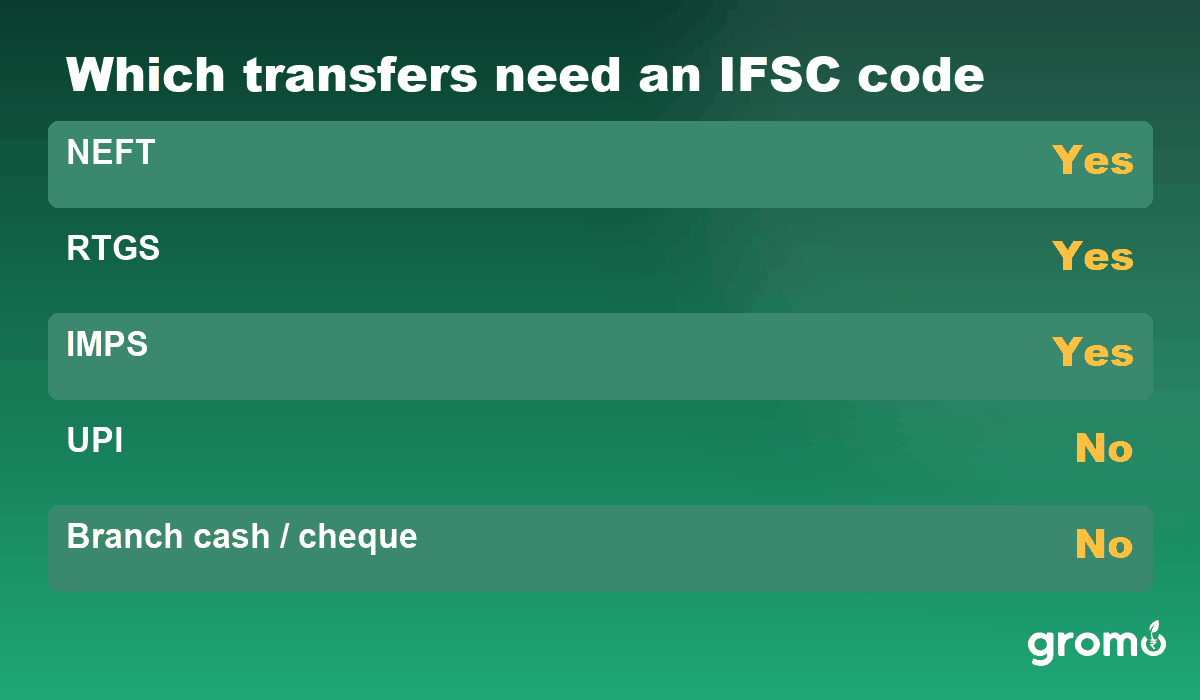
UPI is the exception that catches people out. Image: GroMo.
What happens if I enter the wrong IFSC code?
One of three things, depending on how wrong it is.
The code does not exist. The transfer is rejected outright and the money stays in your account. This is the best outcome.
The code is valid but belongs to another branch of the same bank. Most banks route on the account number in this case and the transfer completes. Not guaranteed, though.
The code is valid and the account number also matches a real account there. The money can reach the wrong person. Recovering it then depends on that person's cooperation and your bank's intervention.
Always check the fifth character is zero and the total length is 11 before confirming a transfer. The same care applies when you're opening an account for the first time, and a zero balance savings account is the usual starting point for most people.
Does my IFSC code ever change?
Yes, and bank mergers are the usual reason. When a bank is merged, the branches of the merging bank are reissued codes under the surviving bank's prefix, and the old codes stop working after a transition period.
If a transfer that used to work starts failing, an outdated IFSC is the first thing to check. Your bank will publish the mapping of old codes to new ones, usually on its website and in the app.
Standing instructions are the quiet casualty here. A recurring transfer set up years ago can keep failing silently after a merger, so it's worth re-checking any automatic payment you rarely look at.
Why this matters if you refer banking products
GroMo is an Indian financial-products distribution platform where individuals refer products from partner banks and NBFCs and earn a commission on approved referrals.
Savings accounts are part of the catalogue, alongside demat accounts and cards, and account-opening questions are the most common ones referrers field. Knowing how IFSC works, and that UPI does not need it, settles a good share of them before they become support tickets.
Current savings account commissions (GroMo product catalogue, retrieved 2026-10-09):
| Product | Commission per approved referral |
|---|---|
| IDFC FIRST Bank Saving Account | ₹600 |
| Kotak 811 Super Account | ₹600 |
| Equitas Selfe Savings Account | ₹250 |
Rates are campaign-linked and change without notice.
Frequently asked questions
Below are the questions people most often ask alongside this one.
What is IFSC code in simple words?
IFSC code is an 11-character code that identifies one bank branch in India. Electronic transfers use it to route money to the correct branch.
What is the full form of IFSC?
Indian Financial System Code.
How many digits is an IFSC code?
Eleven characters in total, not all digits. The first four are letters identifying the bank, the fifth is always zero, and the last six identify the branch.
Is IFSC code the same for all branches of a bank?
No. The first four letters are common to the bank, but the last six characters differ for every branch.
Do I need an IFSC code for UPI?
No. UPI uses a UPI ID or mobile number and handles routing internally. IFSC is needed for NEFT, RTGS and IMPS.
Can two banks have the same IFSC code?
No. Every code is unique to a single branch.
What is the IFSC code full form?
Indian Financial System Code. The Reserve Bank of India assigns one to every branch taking part in electronic fund transfers.
How to find IFSC code by account number?
You cannot derive it from the account number. Check your cheque leaf, passbook, net banking profile or your bank's app, all of which show the branch IFSC directly.
What is IFSC code in banking?
In banking, IFSC is the routing identifier for a branch. NEFT, RTGS and IMPS use it to send money to the right place.
Where is the IFSC code on a cheque?
Printed along the bottom of the cheque leaf, usually beside the account number and the MICR line.
Summary
IFSC code is the Indian Financial System Code, an 11-character identifier for a single bank branch, used by NEFT, RTGS and IMPS but not by UPI. The format is four letters for the bank, a zero, then six characters for the branch. Find yours on a cheque leaf, in your passbook or in your bank's app, and check the fifth character is zero before sending money. If you're setting up a new account first, how to open a savings account walks through that process.
Disclosures
GroMo (Vitrak Technologies Pvt Ltd) is a distribution platform. GroMo is not a bank, NBFC, insurer or investment adviser. All products are offered by their respective RBI, IRDAI or SEBI-regulated providers.
Partner earnings depend on effort, product mix and customer eligibility. Any figures shown are illustrative examples of individual results. They are not typical and are not guaranteed. GroMo does not guarantee any level of income.
Written by Arvind Kumar. Published 9 October 2026. Last updated 9 October 2026.
Sources
- GroMo product catalogue, commission rates by product. Retrieved 9 October 2026.
- Reserve Bank of India maintains the register of allotted IFSC codes. https://www.rbi.org.in/


