
Types of Personal Loans in India 2026
Every type of personal loan in India 2026: secured vs unsecured, purpose-based loans, flexi credit lines and top-ups, with rates and how to choose.

A personal loan is an all-purpose loan, but the market has quietly split it into many types: secured and unsecured, purpose-based loans for weddings, medical bills, and travel, and newer structures like flexi credit lines and top-up loans. They differ in interest rates, approval speed, and who qualifies.
This guide explains every major type of personal loan available in India in 2026, what each one costs, who it suits, and how to pick the right one for your situation.
Personal Loan Types: Quick Facts
| Question | Answer |
|---|---|
| What is a personal loan | A loan for personal needs, usually unsecured, repaid in fixed monthly EMIs |
| Typical interest rate | Roughly 10% to 24% per year unsecured; lower when secured against an asset |
| Typical amount and tenure | Rs 50,000 to Rs 40 lakh, repaid over 1 to 5 years (some lenders longer) |
| Main division | Unsecured (no collateral, most common) vs secured (backed by FD, gold, or property) |
| Purpose-based types | Debt consolidation, medical, wedding, home renovation, travel, education expenses |
| Newer structures | Flexi line of credit, top-up loans, pre-approved instant loans, joint loans |
Secured vs Unsecured Personal Loans
Every personal loan falls on one side of this line, and it is the first choice you make.
Unsecured Personal Loans
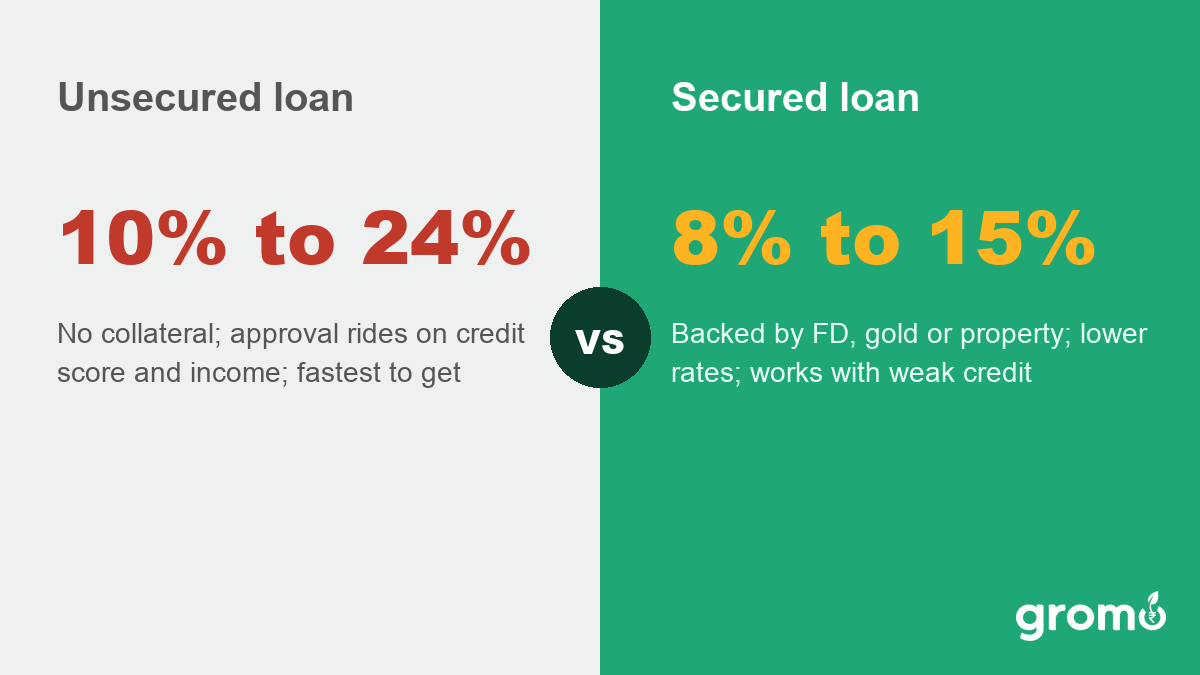
These need no collateral. The bank or NBFC lends purely on your credit score, income, and repayment history, which is why rates are higher, typically 10 to 24 percent a year, and approval leans heavily on your profile.
This is the standard personal loan most people take: fast, document-light, and disbursed in days or even minutes with digital lenders.
Secured Personal Loans
Here you pledge an asset: a fixed deposit, gold, insurance policy, securities, or property. The collateral lowers the lender's risk, so interest rates drop meaningfully and approval becomes possible even with a thin or weak credit history.
Gold loans and loans against FD are the most common secured routes in India, and they often disburse the same day. The risk is equally clear: fail to repay and the pledged asset can be taken.
Personal Loan Types by Purpose
Purpose-based loans are ordinary personal loans packaged for one use, sometimes with tailored amounts, tenures, or offers. The engine underneath is the same unsecured loan.
1. Debt Consolidation Loans
These merge multiple high-interest debts, especially credit card dues running at 36 to 43 percent a year, into one personal loan at a much lower rate with a single EMI.
Consolidation works only with discipline: the moment the old cards are cleared, heavy spending on them must stop, or you end up with both the loan and fresh card debt.
2. Medical Emergency Loans
Built for speed, these cover sudden hospitalisation, surgery, and treatment costs, with many lenders disbursing within hours. Amounts tend to be flexible and paperwork minimal.
Use them for the gap insurance does not cover, and compare against a loan on your FD or gold first, which can be cheaper in the same emergency.
3. Wedding Loans
Wedding loans fund venues, catering, jewellery, and everything around a big Indian wedding. Lenders often allow higher amounts for them.
The caution is built into the occasion: EMIs continue for years after the event, so borrow against a written budget, not the wishlist.
4. Home Renovation Loans
These fund repairs, painting, interiors, and upgrades to a home you already own. For small and mid-size projects they are simpler than extending a home loan, with no property paperwork.
For large renovations, compare with a top-up on your existing home loan, which usually carries a lower rate.
5. Travel Loans
Travel loans pay for flights, hotels, and holiday packages, domestic or international. They are convenient, but they finance a depreciating memory at 12 to 20 percent interest.
Treat them as a last resort or a short-tenure bridge; a few months of saving is almost always the cheaper trip.
6. Education and Skill Loans
Distinct from formal education loans, these personal loans cover short courses, certifications, coaching fees, and upskilling programs where a traditional education loan does not fit. Fast approval matters here because admission windows are short.
Specialized and Alternative Structures
7. Personal Line of Credit (Flexi Loans)
Instead of a lump sum, the lender sanctions a limit you can withdraw from as needed, and interest is charged only on the amount you actually use. Repay and the limit refills.
This suits irregular needs: freelancers smoothing income gaps, or a renovation paid in stages. Watch for annual maintenance charges on the unused limit.
8. Top-Up Loans
Already repaying a personal or home loan with a good track record? Lenders offer an additional amount on top of it, often at rates close to your existing loan and with minimal fresh paperwork. Usually cheaper than starting a brand-new personal loan.
9. Pre-Approved and Instant App Loans
Banks pre-approve loans for existing customers based on account behaviour, and digital lenders disburse small-ticket loans within minutes through apps. Convenience is the product, and rates run higher for the smallest, fastest loans.
Borrow only through RBI approved loan apps whose lender is named clearly inside the app.
10. Cosigned or Joint Loans
A second person with a strong credit profile, a parent, spouse, or sibling, joins the application. Their profile helps a primary borrower with thin credit qualify or secures a better rate. Both credit reports carry the loan, and a missed EMI damages both scores.
All Types Side by Side
| Type | Indicative rate (p.a.) | Best for |
|---|---|---|
| Unsecured personal loan | 10% to 24% | General needs with a good credit score |
| Secured (FD, gold) | 8% to 15% | Lower rates, weak or thin credit history |
| Debt consolidation | 11% to 20% | Clearing credit card dues |
| Medical emergency | 11% to 22% | Speed when insurance falls short |
| Wedding / renovation / travel | 11% to 22% | Planned one-time expenses |
| Flexi line of credit | 12% to 24% on used amount | Irregular, staged needs |
| Top-up loan | Near your existing loan's rate | Extra funds mid-loan |
| Pre-approved / instant app | 12% to 30% | Small urgent amounts |
| Joint / cosigned | 10% to 20% | Thin-credit borrowers with a strong cosigner |
How to Choose the Right Personal Loan
- Name the purpose and exact amount. Borrow for the need, not the maximum the lender offers.
- Check secured options first. If you hold an FD or gold, pledging it usually beats an unsecured rate.
- Compare the APR, not just the headline rate. Processing fees of 1 to 3 percent plus GST change the real cost.
- Match tenure to the purchase. Short tenure for holidays and gadgets, longer only for consolidation or renovation.
- Read the Key Fact Statement for rate, fees, penalties, and foreclosure charges before signing anything.
Eligibility and Documents
Typical requirements across banks and NBFCs: age 21 to 60, a stable income (salaried or self-employed), and a credit score around 700 or above for the best unsecured rates. Secured loans relax the score requirement considerably.
Documents are standard: PAN, Aadhaar or other address proof, salary slips or ITR, and bank statements for the last 3 to 6 months. Digital lenders verify most of this electronically.
Borrow Safely: Three Non-Negotiables
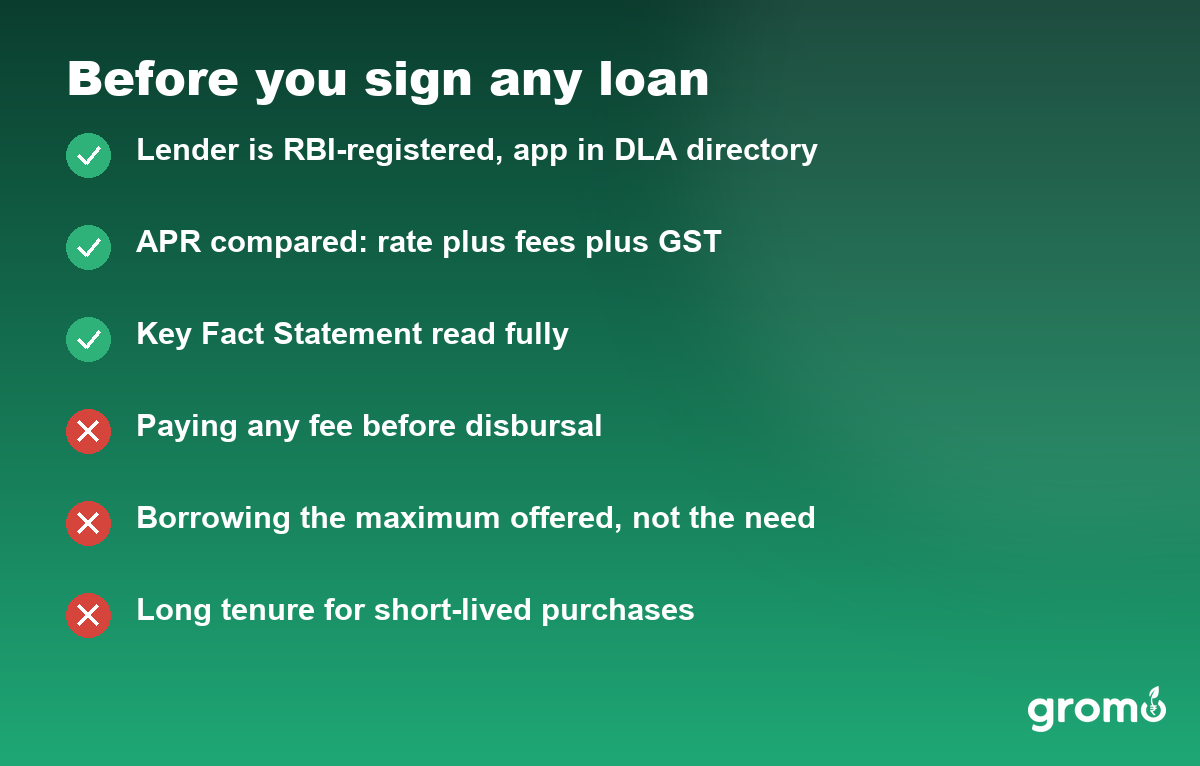
- Verify the lender. The bank or NBFC behind any loan offer must be RBI-registered, and loan apps must appear in the RBI's digital lending directory.
- Never pay upfront. No genuine lender charges a fee before disbursal to "release" a loan; that demand is a scam every time, and the pattern repeats across every known fake loan apps list.
- Protect your EMI record. Every on-time EMI helps improve your credit score; a single default follows you for years.
Comparing Personal Loans on GroMo
Several banks and NBFC lenders offering the loan types above are available for comparison on the GroMo app, where eligibility can be checked digitally and applications tracked in one place. GroMo is a financial product distribution platform, not a lender; loan approval and terms always rest with the bank or NBFC.
FAQ: Types of Personal Loans
What are the types of personal loans in India?
Personal loans divide first into unsecured (no collateral, based on your credit profile) and secured (backed by an FD, gold, or property). Within those, lenders package purpose-based types like debt consolidation, medical emergency, wedding, home renovation, and travel loans, plus newer structures such as flexi lines of credit, top-up loans, pre-approved instant loans, and joint or cosigned loans.
Which type of personal loan has the lowest interest rate?
Secured personal loans are the cheapest: loans against a fixed deposit or gold typically run 8 to 15 percent a year, against 10 to 24 percent for unsecured loans. Among unsecured options, top-up loans on an existing well-paid loan and pre-approved bank offers to existing customers usually price lowest.
The smallest, fastest instant app loans price highest.
What is the difference between a personal loan and a personal line of credit?
A personal loan gives a lump sum with a fixed EMI from day one, and interest runs on the whole amount. A line of credit, or flexi loan, sanctions a limit you draw from as needed, and interest applies only to what you actually use. The loan suits one-time known expenses; the line suits staged or unpredictable needs.
Can I get a personal loan with a low credit score?
Yes, through three routes: a secured loan against your FD or gold where collateral replaces the score, a joint or cosigned loan where a family member's strong profile supports yours, or NBFC lenders that accept thinner files at higher rates. Improving the score first, even for a few months, meaningfully cuts what you will pay.
Which personal loan type is best for clearing credit card debt?
A debt consolidation personal loan, because it swaps card interest of 36 to 43 percent a year for a loan at roughly 11 to 20 percent with one fixed EMI. It works only if card spending stops once the dues are cleared; otherwise the debt doubles across both products.
How do I check if a personal loan app is safe?
Confirm the lender behind the app is an RBI-registered bank or NBFC, check the app in the RBI's digital lending app directory, and read the Key Fact Statement for the rate and all fees before accepting money. Refuse any app that demands an upfront fee to release a loan or wants access to your contacts and photos.
Disclaimer
This article is general information, not financial advice, and nothing here is an offer of credit. Interest rates, fees, amounts, tenures, and eligibility criteria are indicative industry ranges at the time of writing; each bank and NBFC sets its own terms, which change over time, and the lender's Key Fact Statement and official pages are the only authoritative source.
Loan approval is always the lender's decision. Never pay any upfront fee to receive a loan.
GroMo is a financial product distribution platform, not a lender, and is available only to users aged 18 and above. Bank, NBFC, and brand names are trademarks of their respective owners.


