
NEFT vs RTGS vs IMPS: Timing, Limits and Which to Use
NEFT vs RTGS vs IMPS compared on NEFT transaction time, NEFT limit, RTGS minimum and IMPS limit, so you know which transfer method suits each amount.

By Arvind Kumar · Published 9 October 2026 · Updated 9 October 2026
NEFT vs RTGS vs IMPS comes down to three differences: speed, size and settlement style. All three are India's bank-to-bank transfer rails. NEFT settles in batches and runs around the clock. RTGS settles one transaction at a time and is built for large values, with a minimum of two lakh rupees. IMPS is instant and available 24x7, including holidays. All three need the recipient's account number and IFSC code. For most everyday transfers under a lakh, IMPS or UPI is simpler.
Key takeaways- RTGS has a minimum of ₹2 lakh under the Reserve Bank's framework (RBI, retrieved 2026-10-09). Below that, use NEFT or IMPS. - IMPS is instant and works 24x7, including Sundays and bank holidays. - NEFT settles in batches, so arrival is usually quick but not guaranteed instant. - All three need account number plus IFSC. UPI needs neither.
NEFT vs RTGS vs IMPS at a glance
| NEFT | RTGS | IMPS | |
|---|---|---|---|
| Full form | National Electronic Funds Transfer | Real Time Gross Settlement | Immediate Payment Service |
| Settlement | Batch | One by one, real time | Instant |
| Minimum | No minimum | ₹2 lakh (RBI) | No minimum |
| Availability | 24x7 | 24x7 | 24x7 |
| Typical use | Routine transfers | Large value | Urgent, any hour |
| Needs IFSC | Yes | Yes | Yes |
The simplest rule: under ₹2 lakh and urgent, use IMPS. Over ₹2 lakh, use RTGS. Otherwise NEFT is fine.
All three move money between accounts, so they assume you already hold one, and the basics are covered in what a savings account is.
What is NEFT and what is the NEFT transaction time?
NEFT stands for National Electronic Funds Transfer. Transfers are grouped and settled in batches rather than one at a time.
Definition — batch settlement. Transactions are collected over a short window and processed together, rather than each being settled the moment it is submitted.
NEFT transaction time is therefore usually quick but not instantaneous. Money commonly reaches the beneficiary within a short period of the batch processing, and the Reserve Bank of India requires banks to credit or return funds within a defined window. Transfers submitted outside normal banking hours, or to a bank with a processing delay, can take longer.
NEFT runs every day. Holidays included. A transfer initiated late at night will still process, though the credit may land in a later batch than you expect.
What is the NEFT limit?
The Reserve Bank does not set an upper NEFT limit for retail customers. Your bank sets one, and it varies considerably between banks and between channels.
Three things shape the NEFT limit you actually see:
- Your bank's own policy, which differs by account type.
- The channel you use. Net banking usually allows more than the mobile app.
- Beneficiary status. A newly added beneficiary often has a lower cap for the first day or two.
Because the figure differs by bank, check yours in the app rather than relying on a general number. The same applies to the IMPS limit, which banks also set individually.
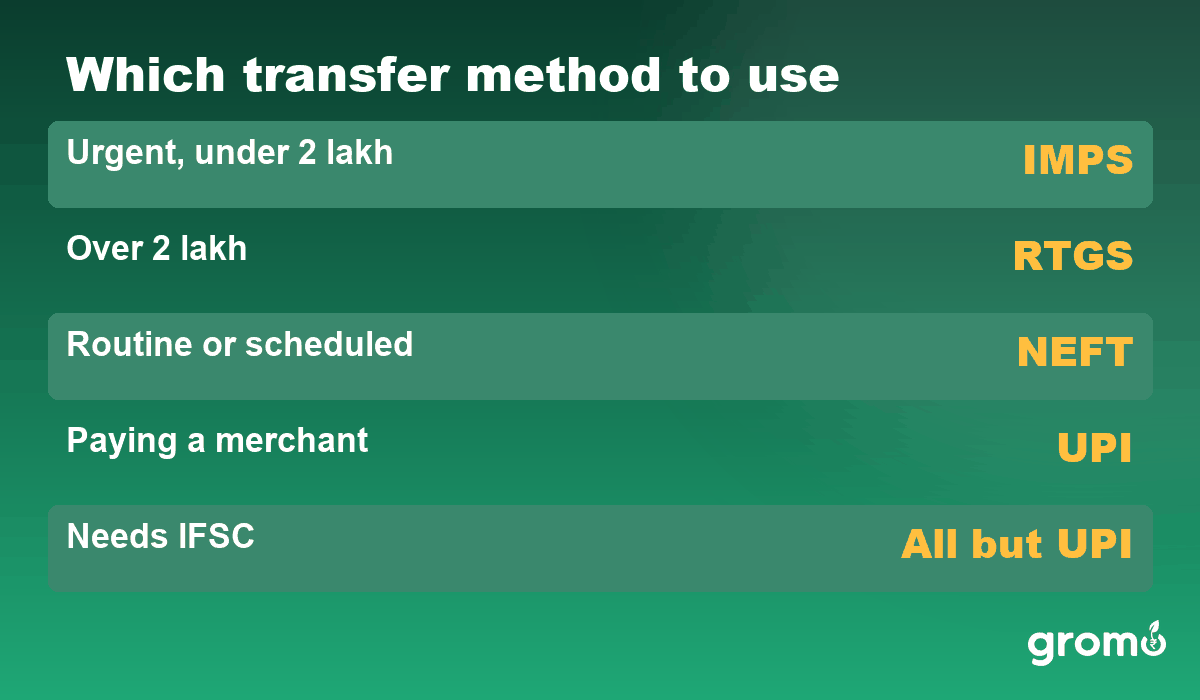
Amount and urgency decide the rail. Image: GroMo.
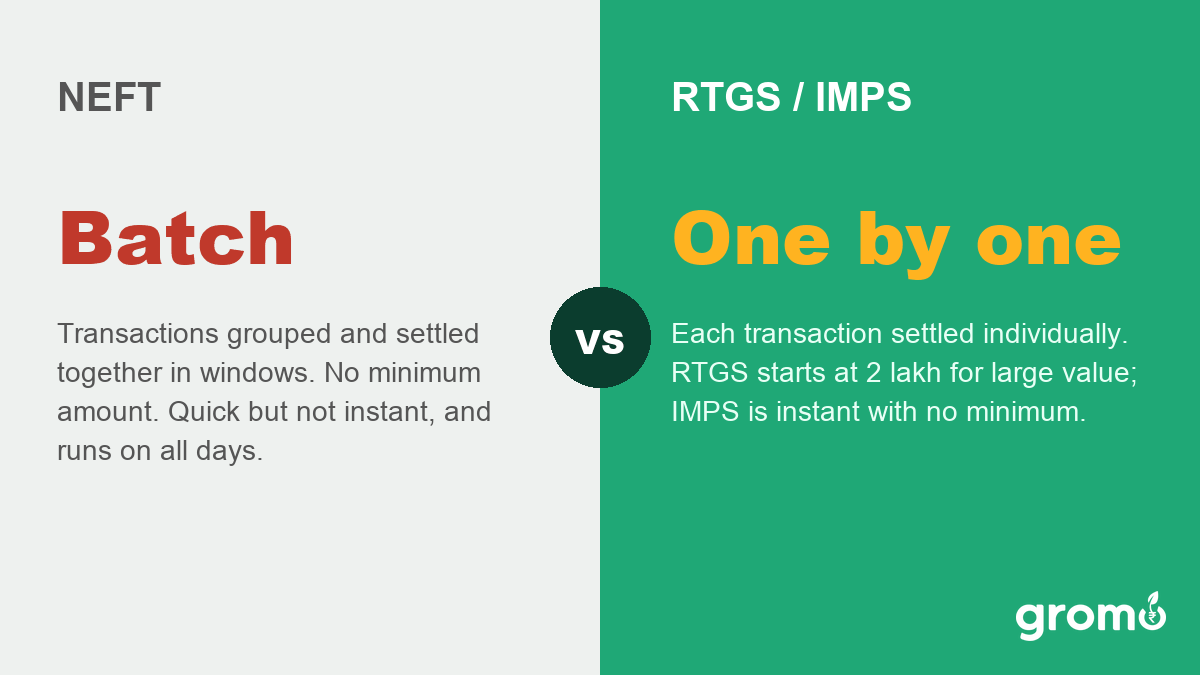
Settlement style is what separates them. Image: GroMo.
What is RTGS and why the two lakh minimum?
RTGS stands for Real Time Gross Settlement. Each transaction is settled individually and immediately, rather than being batched with others.
Individual handling is why RTGS carries a minimum of ₹2 lakh. The system exists for large-value payments where settlement risk matters, so small transfers are routed to NEFT or IMPS instead. There is no regulatory upper limit, though your bank may impose one.
Property payments. Large invoices. Anything where the sender needs certainty the money has moved irrevocably. RTGS is built for those.
Because each transaction settles on its own, there's no waiting for a batch window. The trade-off is that banks sometimes charge more for RTGS than for NEFT, so it isn't the default for ordinary amounts even when you could use it.
What is IMPS and what is the IMPS limit?
IMPS stands for Immediate Payment Service, run by the National Payments Corporation of India. Transfers are instant and available every hour of every day.
IMPS predates UPI and solved the same problem: moving money outside banking hours. Where UPI uses a UPI ID, IMPS uses the account number and IFSC, or in some banks a mobile number plus MMID.
The IMPS limit is set per bank rather than universally. Many banks apply a lower cap in the mobile app than in net banking, which catches people out when a transfer that worked on a laptop fails on a phone.
Which should I use? A practical rule
Paying a person today, any amount under two lakh. Use IMPS, or UPI if you both have it set up.
Paying rent, fees or an EMI on a schedule. Use NEFT, usually set up as a standing instruction.
Buying property, settling a large invoice. Use RTGS, which is built for exactly this.
Paying a merchant or splitting a bill. Use UPI, which needs no IFSC and no beneficiary setup at all.
One practical point for all three: adding a beneficiary often triggers a cooling-off period before large transfers are allowed. If you're paying something time-critical, add the beneficiary a day ahead. The same patience helps when the money is sitting in a demat account and needs moving back first.
What this means if you refer banking products
GroMo is an Indian financial-products distribution platform where individuals refer products from partner banks and NBFCs and earn a commission on approved referrals.
Transfer questions are the ones new account holders ask most, and a referrer who can answer them keeps the customer confident in the account they just opened.
Current savings account commissions (GroMo product catalogue, retrieved 2026-10-09):
| Product | Commission per approved referral |
|---|---|
| IDFC FIRST Bank Saving Account | ₹600 |
| Kotak 811 Super Account | ₹600 |
| Equitas Selfe Savings Account | ₹250 |
Rates are campaign-linked and change without notice. For the opening process itself, how to open a savings account sets out the steps.
Frequently asked questions
Below are the questions people most often ask alongside this one.
What is the difference between NEFT, RTGS and IMPS?
NEFT settles in batches with no minimum, RTGS settles one transaction at a time with a ₹2 lakh minimum, and IMPS settles instantly with no minimum. All three run 24x7 and need the account number and IFSC.
What is NEFT transaction time?
NEFT settles in batches, so the credit is usually quick but not instant. The Reserve Bank requires banks to credit or return the funds within a defined window of settlement.
What is the NEFT limit per day?
The Reserve Bank sets no upper limit for retail NEFT. Your bank sets its own, and it varies by account type and by whether you use the app or net banking.
What is the IMPS limit?
Banks set the IMPS limit individually. The cap in a mobile app is often lower than in net banking at the same bank, so check both.
Is RTGS available 24x7?
Yes. RTGS runs around the clock, though a transfer below the ₹2 lakh minimum will be rejected regardless of timing.
Which is faster, NEFT or IMPS?
IMPS. Transfers are instant, whereas NEFT waits for the next settlement batch.
Do I need an IFSC code for all three?
Yes. NEFT, RTGS and IMPS all route on the account number plus IFSC. Only UPI works without one.
Summary
NEFT, RTGS and IMPS differ on settlement, minimum and speed. NEFT batches transactions with no minimum, RTGS settles individually above a ₹2 lakh floor, and IMPS is instant with no minimum. All three run 24x7 and need an IFSC. Use IMPS for urgent payments under two lakh, RTGS above it, and NEFT for routine scheduled transfers.
Disclosures
GroMo (Vitrak Technologies Pvt Ltd) is a distribution platform. GroMo is not a bank, NBFC, insurer or investment adviser. All products are offered by their respective RBI, IRDAI or SEBI-regulated providers.
Partner earnings depend on effort, product mix and customer eligibility. Any figures shown are illustrative examples of individual results. They are not typical and are not guaranteed. GroMo does not guarantee any level of income.
Transfer limits, charges and cut-off timings are set by individual banks within the Reserve Bank's framework and change from time to time. Check your own bank's current limits in its app or net banking before relying on them.
Written by Arvind Kumar. Published 9 October 2026. Last updated 9 October 2026.
Sources
- Reserve Bank of India, payment systems framework for NEFT and RTGS. Retrieved 9 October 2026. https://www.rbi.org.in/
- National Payments Corporation of India operates IMPS. Retrieved 9 October 2026.
- GroMo product catalogue, commission rates by product. Retrieved 9 October 2026.


