
KYC Full Form: What Is KYC in Banking and How to Complete It
KYC full form is Know Your Customer. What is KYC in banking, the documents accepted, video KYC, re-KYC rules and what happens if your KYC expires.

By Arvind Kumar · Published 9 October 2026 · Updated 9 October 2026
KYC full form is Know Your Customer. KYC is the identity check a bank, NBFC or investment platform runs before it lets you open an account, and periodically afterwards. You prove who you are and where you live, usually with PAN and Aadhaar. Most accounts can now be opened through video KYC in a single call, without visiting a branch. Banks also repeat the check at intervals, which is called re-KYC, and an account whose KYC has lapsed can be frozen until it is updated.
Key takeaways- KYC full form: Know Your Customer. eKYC means the same check done electronically. - PAN and Aadhaar cover the requirement for most retail accounts. - Video KYC completes the process remotely, in one short call. - Re-KYC is a periodic refresh. Ignoring the reminder can get the account frozen.
KYC full form and what is KYC in banking
KYC stands for Know Your Customer. Banks run it so they can be confident an account belongs to a real, identified person, which is what makes money laundering and benami accounts harder.
Definition — KYC. The process of verifying a customer's identity and address before offering a financial product, and re-verifying it at intervals afterwards.
Definition — eKYC. The same verification completed electronically, typically using Aadhaar-based authentication rather than paper copies.
Two things follow. You'll be asked for KYC at every new financial relationship, not once in a lifetime. And the same documents work almost everywhere, so completing it once makes the next account faster — whether that's a savings account or an investment product.
What documents are needed for KYC?
Most institutions accept a short list, and you usually need one from each group.
| Group | Accepted documents |
|---|---|
| Identity | PAN card, Aadhaar, passport, voter ID, driving licence |
| Address | Aadhaar, passport, utility bill, rent agreement, bank statement |
| Photograph | A recent passport-size photo, or a live selfie for video KYC |
PAN is effectively mandatory for most financial products, because it links the account to your tax records. Aadhaar is the quickest route for address, since it satisfies both groups at once.
A document that shows your current address matters more than an old one. If you've moved, update Aadhaar first and the rest becomes straightforward.
One point worth knowing: a document accepted for identity isn't automatically accepted for address, even when it carries both. Institutions set their own list, and a passport that satisfies one bank may need pairing with a utility bill at another. Check the list in the app before you photograph anything.
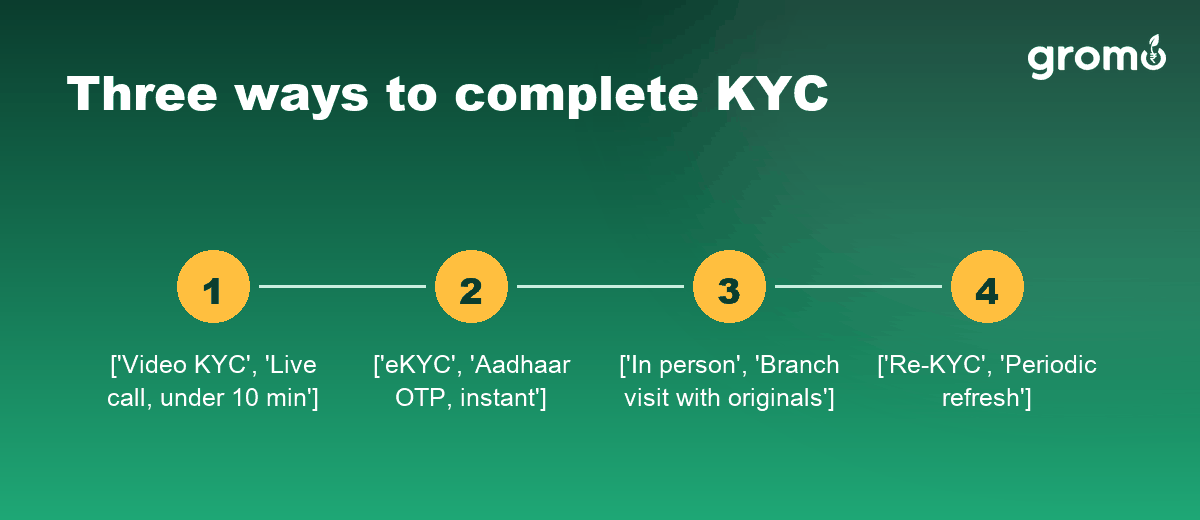
Video KYC has replaced the branch visit for most people. Image: GroMo.
What is video KYC and how does it work?
Video KYC is a short live call with a bank officer that completes verification remotely.
- Start from the app after entering your basic details.
- Join the call when an agent connects, usually within minutes.
- Show your PAN to the camera when asked.
- Confirm your location so the system can record you're in India.
- Answer a question or two and sign on screen if required.
The whole thing usually takes under ten minutes. Keep your original PAN card to hand, sit somewhere well lit, and use a stable connection, because a dropped call means starting again.
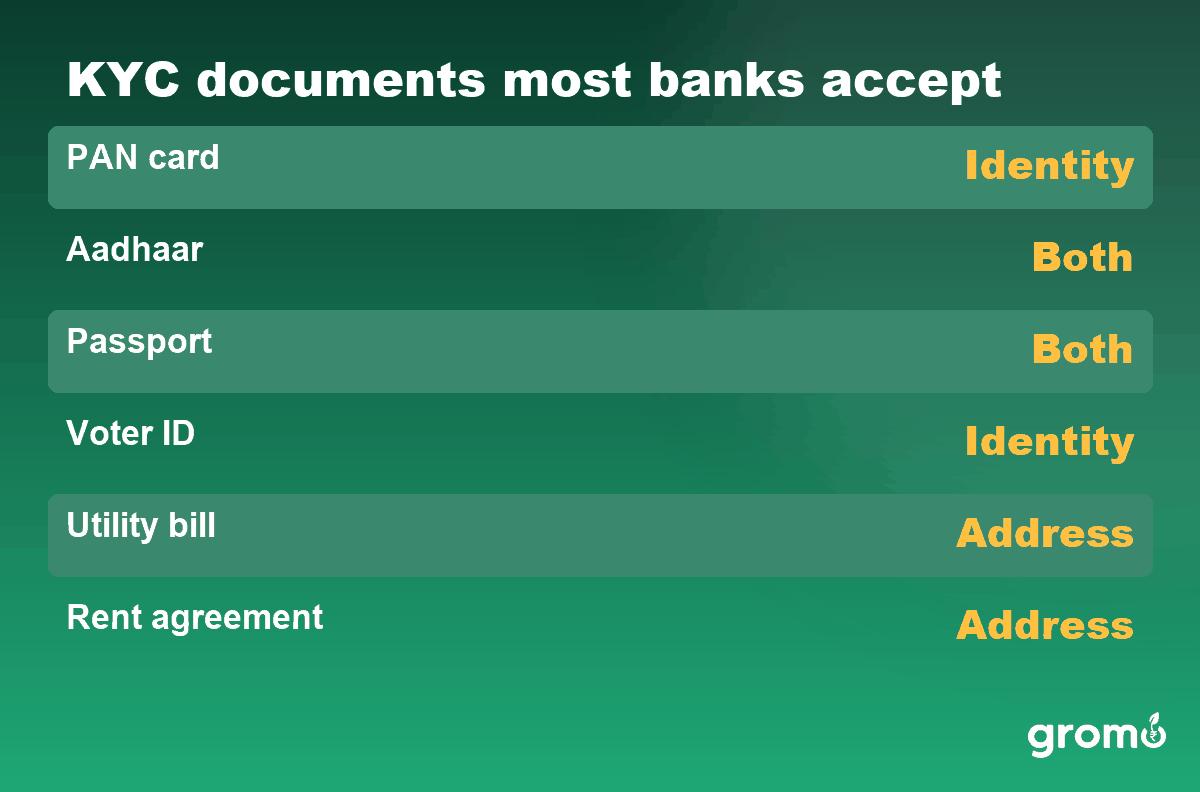
PAN plus Aadhaar covers both groups for most people. Image: GroMo.
What is re-KYC and why does my bank keep asking?
Re-KYC is the periodic refresh of a check you already passed. Regulations require institutions to keep customer records current rather than rely on what you submitted when the account opened.
How often depends on how the institution classifies your risk profile, and low-risk customers are asked least often. Many banks now let you complete re-KYC in the app, or by confirming that nothing has changed.
What happens if you ignore it. The account can be restricted and eventually frozen. Inbound credits may still arrive while outbound transactions are blocked, which is how most people discover the problem. Reactivating means completing the pending re-KYC, and it's far slower than doing it on time.
Is KYC the same everywhere?
Broadly yes for the documents, but not for the record.
A bank, a mutual fund platform and a broker each hold their own KYC. Completing it at one doesn't automatically complete it at another, though a centralised KYC record can speed up the second one considerably.
For investment products specifically, KYC is a precondition rather than a formality. You can browse, but you cannot transact until it clears. The same applies when you open a demat account.
Common KYC problems and how to fix them
Name mismatch between PAN and Aadhaar. The commonest rejection by far. Correct one so both match exactly, including initials and spelling.
Address on Aadhaar is outdated. Update Aadhaar before applying, rather than submitting a second address proof and hoping.
Blurred document photographs. Shoot in daylight, flat on a plain surface, with all four corners visible.
Signature mismatch. Sign as you do on your PAN, not a hurried version.
Mobile number not linked to Aadhaar. eKYC relies on the OTP going to that number. Link it at an enrolment centre first.
Why KYC matters if you refer financial products
GroMo is an Indian financial-products distribution platform where individuals refer products from partner banks, NBFCs and fund houses and earn a commission on approved referrals.
KYC is the single most common reason a referral stalls. The customer applies, the KYC fails on a name mismatch, and the case never converts. Knowing the four or five usual causes lets a referrer fix them before the application rather than after.
Current savings account commissions (GroMo product catalogue, retrieved 2026-10-09):
| Product | Commission per approved referral |
|---|---|
| IDFC FIRST Bank Saving Account | ₹600 |
| Kotak 811 Super Account | ₹600 |
| Equitas Selfe Savings Account | ₹250 |
Rates are campaign-linked and change without notice. Commission is paid only on approved cases, which is precisely why clean KYC matters to a referrer's income. For the account-opening path itself, how to open a savings account sets out the steps.
Frequently asked questions
Below are the questions people most often ask alongside this one.
What is the KYC full form?
Know Your Customer. It's the identity and address verification a financial institution completes before offering you a product.
What is eKYC full form?
Electronic Know Your Customer. The same verification done digitally, usually through Aadhaar-based authentication instead of paper documents.
What is KYC in banking?
In banking, KYC is the check that confirms an account belongs to a real, identified person. Banks run it at account opening and refresh it periodically as re-KYC.
What documents are required for KYC?
Usually PAN for identity and Aadhaar for address, plus a photograph. Passport, voter ID and driving licence are accepted alternatives at most institutions.
How long does video KYC take?
Usually under ten minutes once an agent connects. Keep your original PAN to hand and use a well-lit room with a stable connection.
What happens if KYC is not updated?
The account can be restricted and then frozen. Money may still come in while payments out are blocked, until you complete the pending re-KYC.
Is KYC free?
Banks do not normally charge for KYC or re-KYC. Treat any demand for a fee to "complete KYC", especially over a phone call or link, as a fraud attempt.
Summary
KYC full form is Know Your Customer, the identity and address check every bank, NBFC and investment platform runs before opening an account and periodically afterwards. PAN and Aadhaar cover it for most people, video KYC completes it remotely in under ten minutes, and re-KYC keeps it current. Let it lapse and the account can be frozen, so act on the reminder when it arrives. If you're opening your first account, a zero balance savings account is the usual place to start.
Disclosures
GroMo (Vitrak Technologies Pvt Ltd) is a distribution platform. GroMo is not a bank, NBFC, insurer or investment adviser. All products are offered by their respective RBI, IRDAI or SEBI-regulated providers.
Partner earnings depend on effort, product mix and customer eligibility. Any figures shown are illustrative examples of individual results. They are not typical and are not guaranteed. GroMo does not guarantee any level of income.
KYC requirements, accepted documents and re-KYC intervals are set by each institution under its regulator's rules and change from time to time. Check your own bank's current requirement before applying.
Written by Arvind Kumar. Published 9 October 2026. Last updated 9 October 2026.
Sources
- GroMo product catalogue, commission rates by product. Retrieved 9 October 2026.
- Reserve Bank of India, Master Direction on Know Your Customer. https://www.rbi.org.in/


