
10 Best Ways to Earn Money Online for Students in 2026
Discover the 10 best ways to earn money online for students in 2026 — genuine options for under and over 18s, realistic earnings, and how to pick right.

College life runs on tight budgets — and a side income changes more than your wallet. Students who earn even ₹3,000–₹10,000 a month stop depending on home for every expense, learn how money actually works, and graduate with real skills and work experience on their resume. That head start compounds: the tutoring, design, or sales skills you build at 19 often become the freelance career or business you run at 25.
But here is the part most "earn money online for students" lists skip: choosing the right way matters more than starting fast. Pick something aligned with a skill you want anyway, and every hour pays you twice — once in cash, once in capability. Pick a random app that pays ₹2 per click, and you will burn your study hours for pocket change and learn nothing.
Under 18 or Over 18? What You Can Do
Age matters for legitimate online earning, because real platforms verify identity and payments:
- Under 18: You can tutor juniors, edit videos, design graphics, do freelance projects (often via a parent's account and bank details, with their consent), test websites, and use task or survey apps that allow minors. Focus on skill-building — this is the stage where learning beats earning. (More options in our guide to earning money online for students without investment.)
- 18 and above: Everything above, plus platforms that require KYC — including GroMo, payment-linked freelancing accounts, and refer-and-earn apps with bank payouts. With your own PAN and bank account, you can earn and receive money directly.
1. GroMo — Sell Financial Products, Earn Commissions (18+ Only)
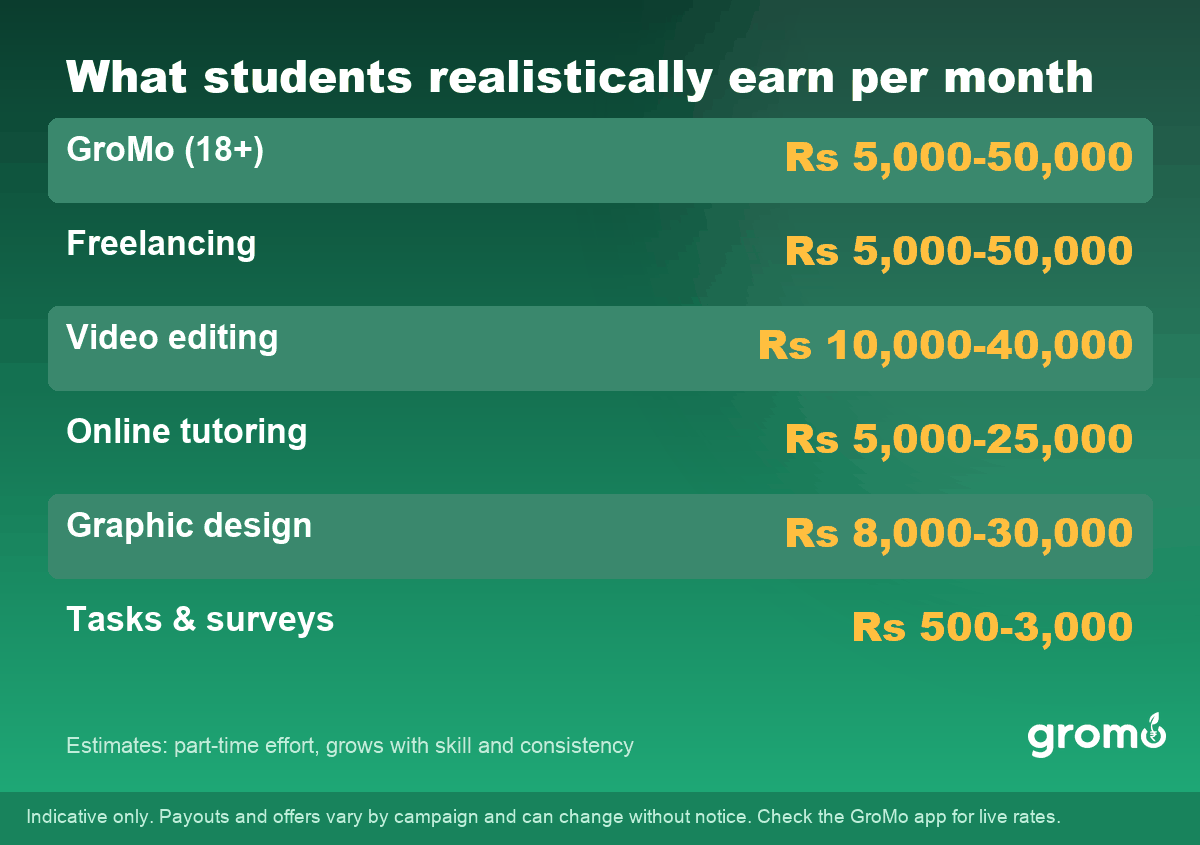
Estimated earning: ₹5,000–₹25,000/month part-time; top student partners cross ₹50,000/month.
GroMo is a zero-investment platform where you earn commissions by helping people in your network get genuine financial products — savings accounts, credit cards, demat accounts, loans, and insurance — from India's leading banks and companies. You share a product with someone who needs it; when their application is approved, you get paid. Commissions are meaningful: a single credit card approval can pay more than a week of survey-filling.
Why it is genuine: The products are real offerings from RBI- and IRDAI-regulated institutions, there is no joining fee, no deposit, and no "buy stock to sell" model — the banks pay for customer acquisition, not you. GroMo is strictly 18+, because financial product distribution requires KYC.
Long-term impact: This is the most underrated part. Working with GroMo forces you to actually understand credit scores, interest rates, insurance cover, and demat accounts years before your peers learn them the expensive way. You graduate with sales skills, a network, and personal-finance literacy — three things that pay for the rest of your life. Many students earn ₹300–₹5,000 daily with GroMo and turn it into a full income after college instead of hunting for jobs.
Start: Download the GroMo app, complete KYC, finish the free training, and begin with the products your friends and family already need.
2. Become a Subject Matter Expert (Online Tutoring)
Estimated earning: ₹200–₹800 per hour; ₹5,000–₹25,000/month with regular students.
If you are strong in maths, science, English, coding, or even a competitive-exam subject you recently cracked, younger students will pay to learn from you. Platforms like Vedantu, Chegg, Superprof, and even WhatsApp-run batches let you teach from your hostel room. Any age can do this — a 17-year-old teaching class-10 maths is completely normal.
Long-term impact: Teaching is the fastest way to master a subject yourself, and it builds communication and patience — skills every interviewer notices. Tutors also build reputations: students who start with two learners often run paid batches of thirty by final year.
Choose this if you genuinely enjoy explaining things and want an income that directly strengthens your own academics.
3. Video Editor
Estimated earning: ₹500–₹5,000 per project; skilled editors make ₹10,000–₹40,000/month.
Every creator, coaching institute, and small business needs shorts, reels, and YouTube edits — demand far exceeds supply of reliable editors. Free tools (DaVinci Resolve, CapCut) are enough to start; clients come from Instagram outreach, freelancing sites, and college networks.
Long-term impact: Video editing is a compounding skill — your showreel gets stronger with every project, and rates climb fast. It can grow into motion graphics, ad-creative work, or your own channel. This is one of the few student skills that can hit ₹50,000+/month within two years of consistent work.
4. Social Media Management
Estimated earning: ₹3,000–₹15,000 per client per month; 2–3 clients is a serious income.
Local businesses — salons, cafes, coaching centres, clinics — know they need Instagram but have no time for it. Students who can plan content, post consistently, reply to comments, and read basic analytics get paid monthly retainers for a few hours of work a week.
Long-term impact: You learn marketing with real stakes — what content converts, how customers think, how businesses make decisions. That experience walks straight into digital-marketing jobs and startup roles, and the client-handling practice is an education in itself.
5. Graphic Design
Estimated earning: ₹500–₹3,000 per design; regular freelancers make ₹8,000–₹30,000/month.
Posters, thumbnails, logos, brochures, and social creatives are endless needs for creators and small businesses. Canva makes starting easy; learning Figma or Photoshop raises your ceiling. Build a small portfolio of 10–15 sample works and pitch — colleges themselves (fests, clubs, societies) are a constant source of first clients.
Long-term impact: Design taste plus tool skill is a career on its own — UI/UX design internships for students with portfolios pay more than many graduate jobs. Even if you go another direction, design skill makes you better at every presentation and project you ever make.
6. Complete-Task-and-Earn Apps
Estimated earning: ₹500–₹3,000/month. Honest ceiling — treat it as pocket money.
Apps that pay small amounts for tasks — app testing, data labelling, small gigs, cashback missions — are fine as a low-commitment starting point, especially for students under 18. The genuine ones pay small and pay on time; that is the deal.
The guidance part: Never pay any joining fee, never share OTPs, and leave any app whose "tasks" are recharging wallets or recruiting friends with deposits — that is a scam structure, not a task app. And do not let ₹40-per-hour tasks eat hours you could spend building an actual skill from this list. Use task apps as a bridge, not a destination.
7. Refer-and-Earn Apps
Estimated earning: ₹500–₹5,000/month casually; more if you have real reach.
Apps across payments, shopping, and finance pay you for bringing new users. If friends are opening an account or app anyway, your referral link costs them nothing and pays you something. Most bank-linked referral programs require you to be 18+ for payouts.
Long-term impact: Referrals teach you the basics of distribution — trust, timing, and recommending only what you would use yourself. Students who get good at this graduate naturally into higher-paying referral models: this is exactly the skill that platforms like GroMo pay serious commissions for, with financial products instead of ₹50 app bonuses.
8. Freelancing (Writing, Coding, Translation, VA Work)
Estimated earning: ₹5,000–₹50,000/month depending on skill and consistency.
Freelancing marketplaces like Upwork, Fiverr, and Internshala connect students to paid work in content writing, web development, data work, translation, and virtual assistance. Start with small projects, over-deliver, collect reviews — your rate roughly doubles with every ten good reviews.
Long-term impact: Freelancing is a career simulator: you learn pricing, deadlines, client communication, and self-discipline. Many students never "get a job" because their freelance profile becomes the job — and the portfolio makes campus placements easier for those who want them.
9. Website Testing
Estimated earning: ₹300–₹1,000 per test; ₹2,000–₹8,000/month with regular invites.
Companies pay real users to try their websites and apps while speaking thoughts aloud — platforms like UserTesting and similar panels send paid tests you complete in 15–20 minutes with a mic and screen recorder. Clear English and a quiet room are the main requirements.
Long-term impact: You develop an eye for UX — why some apps feel effortless and others frustrating. For anyone aiming at product, design, or development careers, being paid to critique real products is quietly excellent training.
10. Micro Surveys
Estimated earning: ₹500–₹2,500/month. The smallest earner on this list — and that is okay.
Survey panels pay small rewards for opinions. They work at any age, need zero skill, and fit in dead time between classes. Stick to established, legitimate earning apps and panels, expect disqualifications from some surveys, and never pay to join one — genuine research panels are always free.
Guidance: Surveys are a fine first rupee online. But notice the pattern of this list: the earning ceiling rises with the skill required. Use surveys to learn that online money is real, then climb.
A Warning Before You Chase Faster Money: Trading and "Investment" Traps
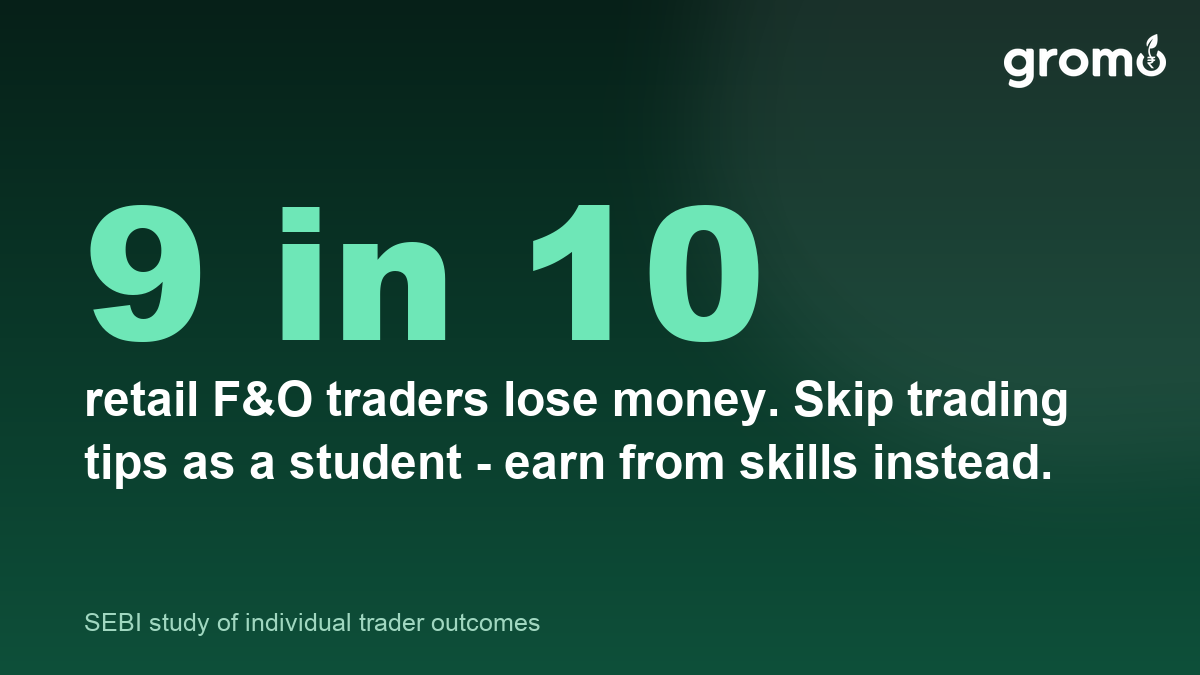
Now that you have seen the genuine list, one honest caution before you decide. Students are the number one target for trading and investment scams — Telegram "stock tip" groups, apps promising to double money in weeks, courses selling F&O trading dreams, and crypto schemes run by people who earn from your deposits, not from markets. SEBI's own studies show that the vast majority of retail F&O traders lose money — and those are adults with income. As a student, you have no income cushion, which makes leveraged trading closer to gambling than earning.
Simple rule for this stage of life: earn from your skills and time, invest only small amounts in boring instruments (SIPs, index funds) once you actually have income, and treat anyone promising guaranteed or quick returns as a fraud by default. Everything on the list below pays you for work — not for deposits.
So Which One Should You Choose?
- Under 18: Start with tutoring if you are academically strong, or video editing/graphic design if you are creative. Add task apps or surveys only as filler.
- 18+ and people-oriented: GroMo is the strongest pick — highest earning ceiling on this list, zero investment, and it teaches you finance while paying you. Pair it with refer-and-earn habits you already have.
- 18+ and skill-oriented: Freelancing, video editing, or social media management — choose the one you would practise even unpaid, because that is the one you will stick with.
- Whatever you pick: give it 90 focused days before judging it. And if you want the full menu beyond online-only options, our guide to the best ways to make money as a student covers 15 methods including campus-based ones. Every option on this list pays badly in week one and surprisingly well in month six.
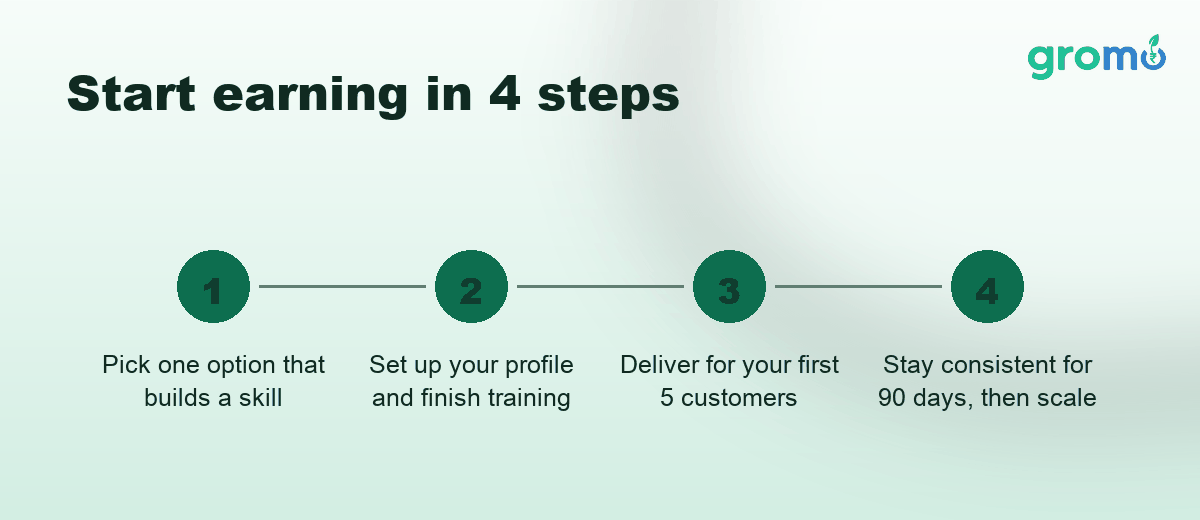
The honest summary: as a student, your best investment is not stocks, crypto, or trading courses — it is a skill plus a real earning platform. Start small, stay consistent, avoid anything that asks for money to make money, and let your side income fund both your expenses and your financial education. If you are 18 or older and want the option with the highest long-term payoff, download GroMo, complete the free training, and earn your first commission from your existing network — no investment, just effort.
FAQ: Earning Money Online as a Student
How can a student earn money online without investment?
Every option in this list works without investment: tutoring, freelancing, video editing, design, website testing, surveys, and task apps need only a phone or laptop and your time. For students 18 and above, GroMo is a genuine zero-investment option — you earn commissions for helping people get real financial products, with no joining fee or deposit. Any platform that asks for money before you can earn should be treated as a scam.
Can I earn money online as a student under 18?
Yes. Under-18 students can tutor juniors, edit videos, design graphics, take freelance projects (with a parent's account and consent for payments), test websites, and use survey or task apps that allow minors. Platforms that need KYC and bank payouts — including GroMo — require you to be 18 or older.
Which is the best earning website or app for students?
It depends on your age and strengths. Under 18, online tutoring pays best if you are academically strong, and video editing or design if you are creative. Over 18, GroMo has the highest earning ceiling on this list (Rs 5,000-50,000+ per month) and teaches you personal finance while you earn. Skill-based freelancing is the best long-term pick if you already have a marketable skill.
How much money can a student earn online per month?
Realistic ranges: surveys and task apps pay Rs 500-3,000 per month; website testing Rs 2,000-8,000; tutoring Rs 5,000-25,000; design Rs 8,000-30,000; video editing Rs 10,000-40,000; and freelancing or GroMo Rs 5,000-50,000+ depending on effort and consistency. Most options pay little in the first month and grow meaningfully by month three to six.
Is GroMo genuine for students?
Yes — GroMo is a genuine platform for students aged 18 and above. The products you distribute are real offerings from RBI- and IRDAI-regulated banks and insurers, there is no joining fee, and commissions are paid to your bank account after approvals. Beyond income, it builds long-term financial literacy: you learn how credit scores, insurance, loans, and demat accounts work years before most graduates do.
Should students do trading or crypto to make money fast?
No. SEBI's studies show the large majority of retail F&O traders lose money, and students have no income cushion to absorb losses. Telegram tip groups, guaranteed-return schemes, and courses selling quick trading profits target students specifically. Earn from your skills and time first; invest small amounts in simple instruments like SIPs only after you have an income.
Disclaimer
Nothing here is a guarantee of income. All earning figures in this article are indicative estimates based on typical part-time effort; actual earnings depend on your skill, consistency, location, and demand, and platform rates change over time. GroMo commissions are set by the partner banks and financial institutions, vary by product and campaign, and are paid only on approved applications — check the live commission in the GroMo app before relying on any figure. GroMo is available only to users aged 18 and above.
Everything above is general information, not financial or career advice. Students under 18 should involve a parent or guardian for any platform that handles payments, and no legitimate platform ever requires a fee, deposit, or OTP sharing to let you earn.


