
Credit Card Charges for Late Payment: Bank-Wise Fees 2026
Credit card charges for late payment explained: bank-wise late fee slabs for SBI, HDFC, ICICI, Axis and more, interest costs, RBI rules, and how to avoid them.

Miss a credit card due date and the damage is never just one fee. Credit card charges for late payment arrive as a stack: a late fee based on your outstanding amount, finance charges on your balance, GST on top of the fees, the loss of your interest-free period, and, if the delay stretches, a dent in your CIBIL score (see how to improve your credit score) that outlasts every rupee you pay. This guide explains the full stack first, then lists bank-wise late payment charges so you know exactly what your card will cost you if the bill slips.
What Actually Happens When You Pay Late
- Late payment fee: a slab-based charge tied to your outstanding amount, typically nil below Rs 100-500 and rising to Rs 1,200-1,300 for balances above Rs 50,000. Bank-wise slabs are listed below.
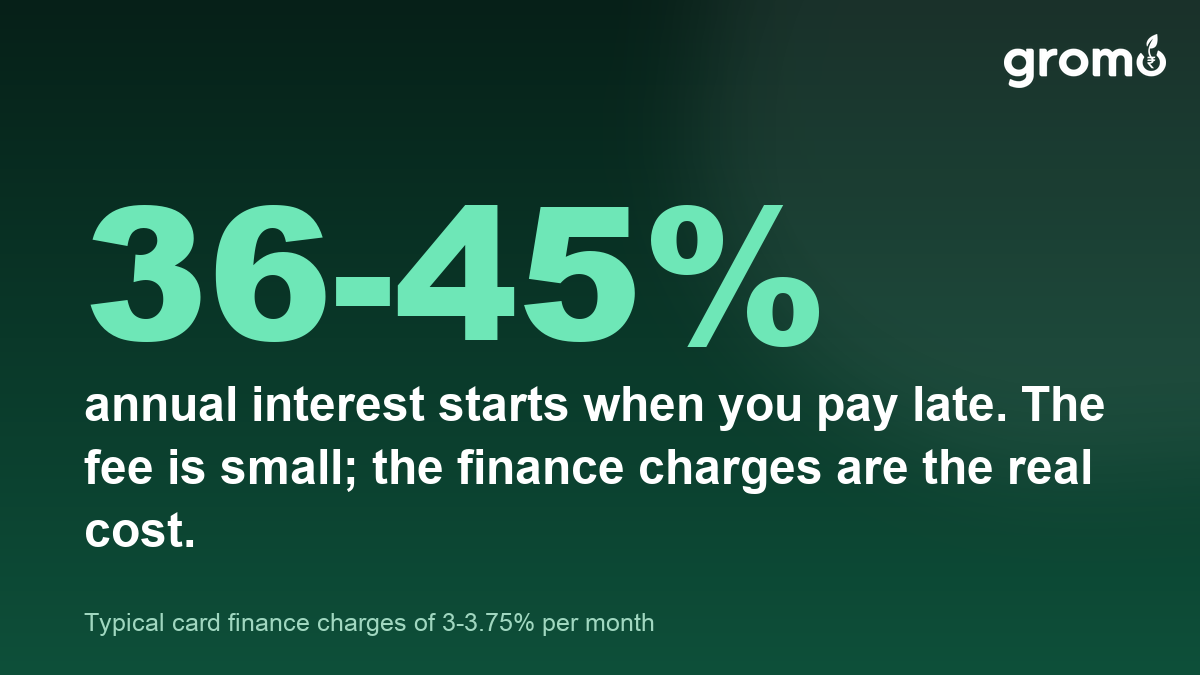
- Finance charges (the bigger cost): interest of roughly 3-3.75% per month (36-45% annually) starts applying on your outstanding balance. This usually costs far more than the late fee itself.
- Loss of the interest-free period: once you carry a balance, new purchases also accrue interest from day one until you clear the full outstanding.
- GST: 18% GST applies on the late fee and finance charges, quietly inflating the total.
- Credit score impact: payments reported past due hurt your CIBIL score, and a 30+ day delay can stay on your report for years, raising the cost of every future loan.
The RBI Rules That Protect You
- Three-day window: RBI's card rules require issuers to charge late fees and report a card as past due only if payment is not received within three days after the due date. A payment that lands a day late usually escapes both.
- Penal charges only on the overdue amount: late fees must be levied on the unpaid outstanding, not on your total limit or an inflated base.
- No interest on penal charges: banks cannot compound interest on the penalty itself.
- Minimum due is a trap, not a target: paying the minimum avoids the late fee but keeps finance charges running on the rest. It protects your score, not your wallet.
Bank-Wise Credit Card Late Payment Charges
Late fees are slab-based: the more you owe on the due date, the higher the fee. These are the published slabs of major issuers; banks revise them periodically, so always confirm on your bank's schedule of charges.
SBI Card Late Payment Charges
| Outstanding amount | Late fee |
|---|---|
| Up to Rs 500 | Nil |
| Rs 501 - Rs 1,000 | Rs 400 |
| Rs 1,001 - Rs 10,000 | Rs 750 |
| Rs 10,001 - Rs 25,000 | Rs 950 |
| Rs 25,001 - Rs 50,000 | Rs 1,100 |
| Above Rs 50,000 | Rs 1,300 |
HDFC Bank Credit Card Late Payment Charges
| Outstanding amount | Late fee |
|---|---|
| Below Rs 100 | Nil |
| Rs 100 - Rs 500 | Rs 100 |
| Rs 501 - Rs 5,000 | Rs 500 |
| Rs 5,001 - Rs 10,000 | Rs 600 |
| Above Rs 10,000 | Rs 750 - Rs 950+ by slab |
ICICI Bank Credit Card Late Payment Charges
| Outstanding amount | Late fee |
|---|---|
| Up to Rs 100 | Nil |
| Rs 101 - Rs 500 | Rs 100 |
| Rs 501 - Rs 10,000 | Rs 500 |
| Above Rs 10,000 | Rs 750 |
Axis Bank Credit Card Late Payment Charges
| Outstanding amount | Late fee |
|---|---|
| Up to Rs 300 | Nil |
| Rs 301 - Rs 500 | Rs 100 |
| Rs 501 - Rs 1,000 | Rs 500 |
| Higher slabs | Up to Rs 1,200 above Rs 50,000 |
Standard Chartered Credit Card Late Payment Charges
| Outstanding amount | Late fee |
|---|---|
| Rs 101 - Rs 500 | Rs 100 |
| Mid slabs | Rising by amount |
| Above Rs 15,000 | Rs 800 |
HSBC Credit Card Late Payment Charges
| Structure | Late fee |
|---|---|
| Percentage model | 100% of minimum due, subject to a minimum of Rs 250 and maximum of Rs 1,200 |
RBL Bank Credit Card Late Payment Charges
| Structure | Late fee |
|---|---|
| Percentage model | 15% of total amount due, subject to a minimum of Rs 50 and maximum of Rs 1,000 |
Other Issuers (IDFC FIRST, Kotak, AU and More)
Several newer issuers use percentage models similar to RBL, typically 15% of the total amount due with minimum and maximum caps around Rs 100-1,300, while others follow slab structures close to the tables above. The exact figure always lives in one document: your card's Most Important Terms and Conditions (MITC) or schedule of charges on the issuer's website.
How to Avoid Late Payment Charges
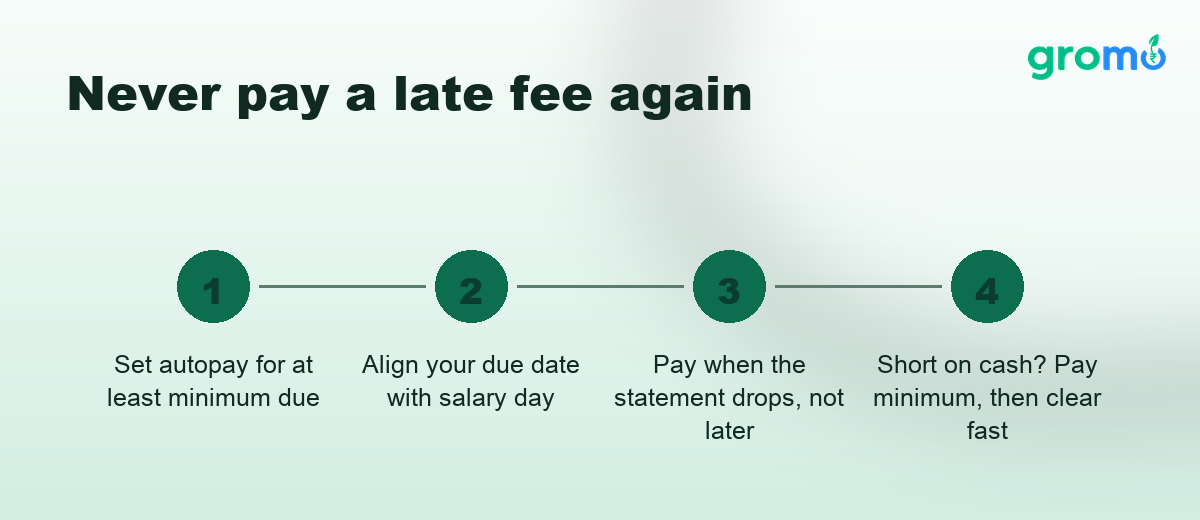
- Set up autopay for at least the minimum due, with full-amount autopay as the safer default.
- Move your due date near your salary date; most banks allow this from the app.
- Keep bill alerts on and pay when the statement drops, not when the due date arrives.
- If cash is short, pay the minimum due before the due date to avoid the fee and score damage, then clear the rest at the earliest.
- Convert large bills you cannot clear into EMIs before the due date instead of silently revolving.
- Missed by a day or two? Pay immediately: within the three-day window you can usually avoid both the fee and bureau reporting.
Already Charged? How to Get a Late Fee Waived
- Pay the full outstanding first; banks rarely discuss waivers on unpaid balances.
- Call customer care, mention your on-time payment history, and request a one-time goodwill waiver.
- If you hold a good record, most issuers reverse a first offence; get the confirmation in writing.
- If the charge violates RBI norms (for example, a fee despite payment within three days), escalate to the bank's grievance cell and then the RBI Ombudsman.
The real cost of late payments on credit cards is never the Rs 500 fee; late payments also cancel every one of your credit card benefits. It; it is the 36-45% interest, the lost interest-free period, and a scarred credit report quietly raising the price of your next home loan. Automate the payment, respect the three-day rule as an emergency cushion rather than a habit, and the fee tables above stay exactly what they should be: trivia you never pay.
FAQ: Credit Card Late Payment Charges
What are the credit card charges for late payment in India?
Three charges stack up: a slab-based late fee (nil below roughly Rs 100-500 outstanding, rising to Rs 1,200-1,300 above Rs 50,000 depending on the bank), finance charges of about 3-3.75% per month on the outstanding balance, and 18% GST on the fees. You also lose the interest-free period on new purchases until the full balance is cleared.
How much is the late fee on a credit card payment?
It depends on your bank and outstanding amount. Typical slabs: SBI Card charges Rs 400-1,300, HDFC Rs 100-950+, ICICI Rs 100-750, and Axis Rs 100-1,200, while HSBC and RBL use percentage models with caps around Rs 1,000-1,200. Small balances (under Rs 100-500) usually attract no fee. Check your card's schedule of charges for the exact slab.
Does one late credit card payment affect my CIBIL score?
If you pay within three days of the due date, RBI rules generally protect you from both the fee and bureau reporting. Beyond that, the account can be reported past due, and a 30+ day delay typically causes a meaningful score drop that stays on your report for years. Pay at least the minimum due before the due date to protect your score, then clear the rest fast.
What is the interest charged on late credit card payments?
Finance charges of roughly 3-3.75% per month, which is 36-45% annualised, apply on your outstanding balance from the transaction date once you miss full payment. This interest, not the late fee, is the biggest cost of paying late, and it also applies to new purchases until you clear the entire outstanding.
Can I get my credit card late fee waived?
Often, yes, if it is your first slip. Pay the full outstanding, call customer care, cite your on-time history, and request a goodwill waiver; most issuers reverse a first offence. If you paid within three days of the due date and were still charged, cite the RBI card rules, escalate to the bank's grievance cell, and then the RBI Ombudsman if needed.
Is it better to pay the minimum due than to pay late?
Always. Paying the minimum due by the due date avoids the late fee and protects your credit report. But it is damage control, not a strategy: finance charges keep running on the remaining balance, so clear the full outstanding as soon as possible and switch to full-amount autopay.
Disclaimer
This article is general information, not financial advice. All late fee slabs, finance charge rates, and rules reflect publicly available bank schedules at the time of writing; banks revise charges periodically and the figures for your card may differ. The only authoritative source is your card's Most Important Terms and Conditions (MITC) and the schedule of charges on your issuing bank's website; always verify there before relying on any figure. Bank names are trademarks of their respective owners.


