
Best Online Business Ideas for Beginners in India 2026
Looking for a business idea for beginners? Compare the 10 best online business ideas from home in India 2026 — startup costs, realistic earnings, how to choose.

The best business idea for a beginner is not the most exciting one — it is the one you can start this week, run from home, and afford to get wrong. That usually means an online business: no shop rent, no staff, no inventory gathering dust, and customers you can reach from your phone. In 2026, the cheapest businesses to start from home cost less than a restaurant meal to launch — several cost nothing at all.
But "easy to start" cuts both ways. Because anyone can begin, the difference between a hobby and a business is how you run it: pick one idea, serve real customers, track what you earn against the hours you spend, and reinvest in what works. This guide covers 10 online business ideas for beginners in India — what each really takes, what it costs to start, realistic monthly earnings, and who it suits — so you choose like an owner, not a browser.
1. Sell Financial Products with GroMo
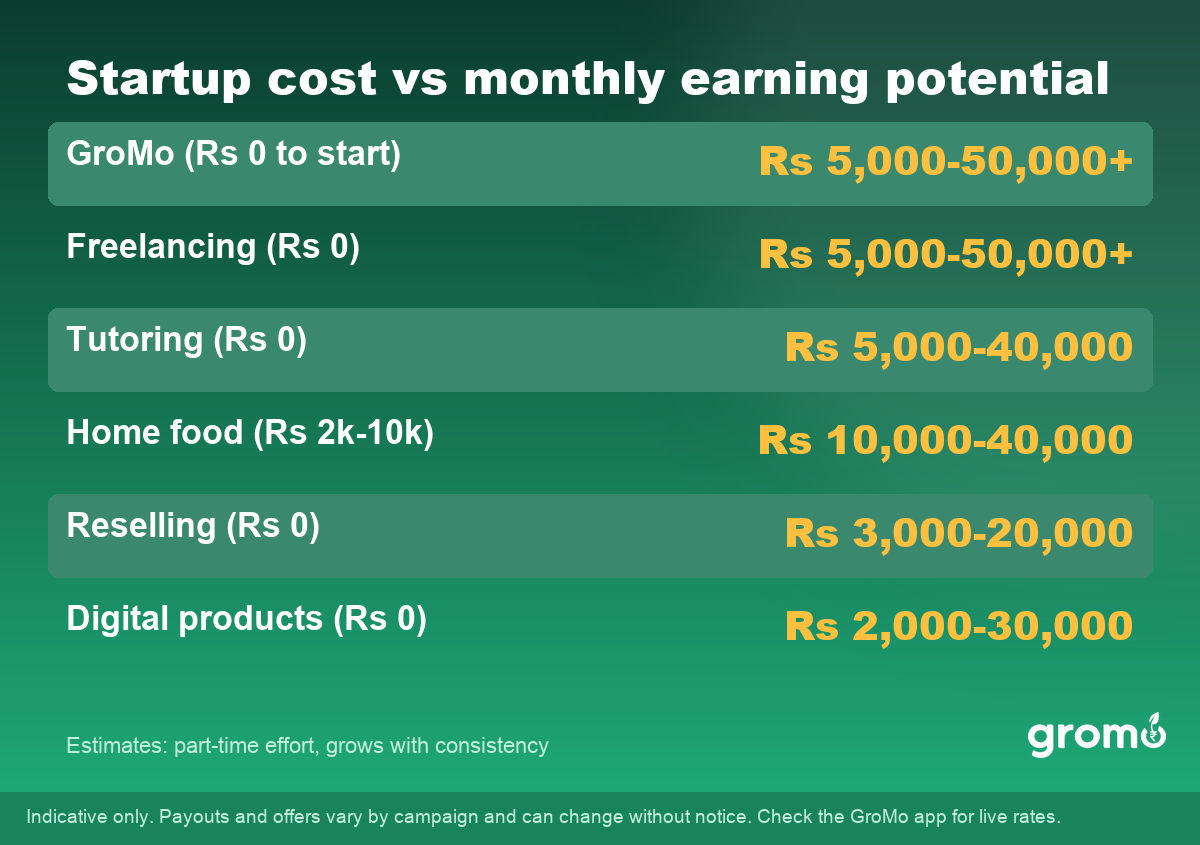
Startup cost: ₹0. Earning potential: ₹5,000–₹50,000+ per month. The best beginner business on this list.
Financial product distribution is one of India's most overlooked business models — and GroMo removes every traditional barrier to entering it. As a GroMo Partner, you run a micro-distribution business: you help people in your network get savings accounts, credit cards, demat accounts, loans, and insurance from India's leading banks and regulated financial companies, and the institutions pay you a commission on every approved application. A single approved credit card can pay ₹1,000–₹2,000+.
Why it works as a business, not just a side gig:
- Zero capital, zero inventory: the "products" are digital applications — nothing to buy, stock, or ship. Your only investments are time and trust.
- A real customer base: every satisfied customer returns for the next product — the person who opened a savings account through you needs a credit card next year, then insurance, then a demat account. Repeat revenue is what makes it a business.
- Free training and support: GroMo teaches you each product before you sell it, so you grow into a trusted financial advisor for your circle rather than a link-forwarder.
- Scales with your network: partners start with friends and family, then grow through referrals and local reputation. Top partners treat it full-time and cross ₹50,000–₹1,00,000 a month.
How to run it as a business: set a weekly customer target, keep a simple record of who needs what, follow up on pending applications through the app's dashboard, and ask every happy customer for one introduction. That loop — serve, track, follow up, referral — is the entire machine.
Right for you if: you have a network that trusts you and you want the highest earning ceiling available to a beginner with zero investment.
2. Reselling Business with Meesho and WhatsApp
Startup cost: ₹0. Earning potential: ₹3,000–₹20,000 per month.
Reselling apps let you share catalogue products — clothing, home goods, accessories — with your own margin added on top; the platform handles delivery, payment, and returns. You are effectively running a boutique with no inventory. The business skill here is curation: resellers who learn their audience's taste and share a focused selection consistently outsell those who forward entire catalogues.
Right for you if: you have active WhatsApp groups and social circles and enjoy spotting what people will love.
3. Freelance Services Business (Writing, Design, Development)
Startup cost: ₹0–₹500. Earning potential: ₹5,000–₹50,000+ per month.
Selling a skill is the fastest route from zero to revenue. Writing, graphic design, video editing, web development, and translation all sell daily on Fiverr, Upwork, and Internshala. Treat it as a business from day one: define fixed-scope packages, deliver on time, collect reviews, and raise prices every ten projects. Freelancers who systemise like this often evolve into small agencies — subcontracting overflow work is how a solo gig becomes a firm.
Right for you if: you have (or will spend two weeks learning) one marketable skill.
4. Online Tutoring and Coaching
Startup cost: ₹0. Earning potential: ₹5,000–₹40,000 per month at ₹200–₹800 per hour.
Academic subjects, competitive exams, spoken English, music, even fitness — if you can teach it over a video call, it is a home business. Start on platforms like Vedantu or Superprof for demand, then build your own batches on WhatsApp where you keep 100% of the fee. The business move is productising: fixed courses with start dates and outcomes earn more than open-ended hourly classes.
Right for you if: you are strong in a subject and patient with learners.
5. Social Media Management for Local Businesses
Startup cost: ₹0. Earning potential: ₹3,000–₹15,000 per client per month.
Salons, cafes, coaching centres, and clinics all know they need Instagram and none have time for it. Offer a simple monthly package — content calendar, posts, replies, a monthly report — and land your first client by doing a free two-week trial for a business you already visit. Three retainer clients is a serious home income; ten is an agency.
Right for you if: you understand social platforms and can commit to consistency on someone else's behalf.
6. Print-on-Demand and Custom Merchandise
Startup cost: ₹0–₹2,000. Earning potential: ₹2,000–₹25,000 per month at 20–40% margins.
Design t-shirts, mugs, and posters; a print-on-demand partner prints and ships each order, so you hold no stock. Winners niche down — designs for one college, one profession, one fandom — because generic merchandise drowns in competition. Pair it with an Instagram page for your niche and the store markets itself.
Right for you if: you have design sense and want a product business without inventory risk.
7. Digital Products Business (E-books, Templates, Courses)
Startup cost: ₹0. Earning potential: ₹2,000–₹30,000+ per month.
Make something useful once — study notes, resume templates, budget spreadsheets, a short course — and sell it repeatedly. This is the closest a beginner gets to passive income without capital: margins are near 100% and delivery is automatic. The catch is honest: you need distribution, so build a small audience (or use marketplaces) before expecting sales.
Right for you if: you have expertise worth packaging and the patience to market it.
8. Affiliate Marketing and Niche Content Sites
Startup cost: ₹0–₹3,000. Earning potential: ₹1,000–₹50,000+ per month, slow build.
Recommend products through content — a blog, Instagram page, or YouTube channel — and earn a commission on every sale or signup through your links. Financial products pay far better per conversion than retail affiliate programs, which is why many Indian creators pair content with GroMo instead of earning a few rupees per Amazon order. Expect months of building before meaningful income; expect compounding after.
Right for you if: you enjoy creating content and can play a long game.
9. YouTube Channel as a Business
Startup cost: ₹0–₹3,000. Earning potential: ₹0 for months, then ₹5,000–₹1,00,000+.
A channel in a niche you genuinely know — local food, exam prep, personal finance, farming, repair work — monetises through ads, sponsorships, and affiliate income once the audience arrives. Run it like a business: fixed upload schedule, one niche, and a monetisation plan beyond ad revenue. The ceiling is the highest on this list; so is the patience required.
Right for you if: you can publish consistently for six months without a payout.
10. Home Food Business with Online Orders
Startup cost: ₹2,000–₹10,000. Earning potential: ₹10,000–₹40,000 per month.
Tiffin services, baking, snacks, and regional specialities sell through WhatsApp, Instagram, and local delivery apps. It is the most proven home business in India — demand is daily and loyalty is strong. Start with a small weekly menu, take pre-orders to avoid waste, and get the basic FSSAI registration early; it is inexpensive and unlocks bigger platforms.
Right for you if: you cook well and want a business rooted in your locality.
Which Business Idea Should a Beginner Choose?
- Best overall for beginners: selling financial products with GroMo — zero cost, highest ceiling, built-in training, and repeat customers from day one.
- Cheapest to start from home: GroMo, reselling, tutoring, freelancing, and digital products all start at ₹0 — the only spend is your time.
- Fastest first revenue: freelancing and tutoring — you can invoice in week one.
- Biggest long-term ceiling: YouTube, affiliate content, and digital products — slow starts, compounding payoffs.
- Most local and offline-friendly: the home food business — online ordering, offline delivery.
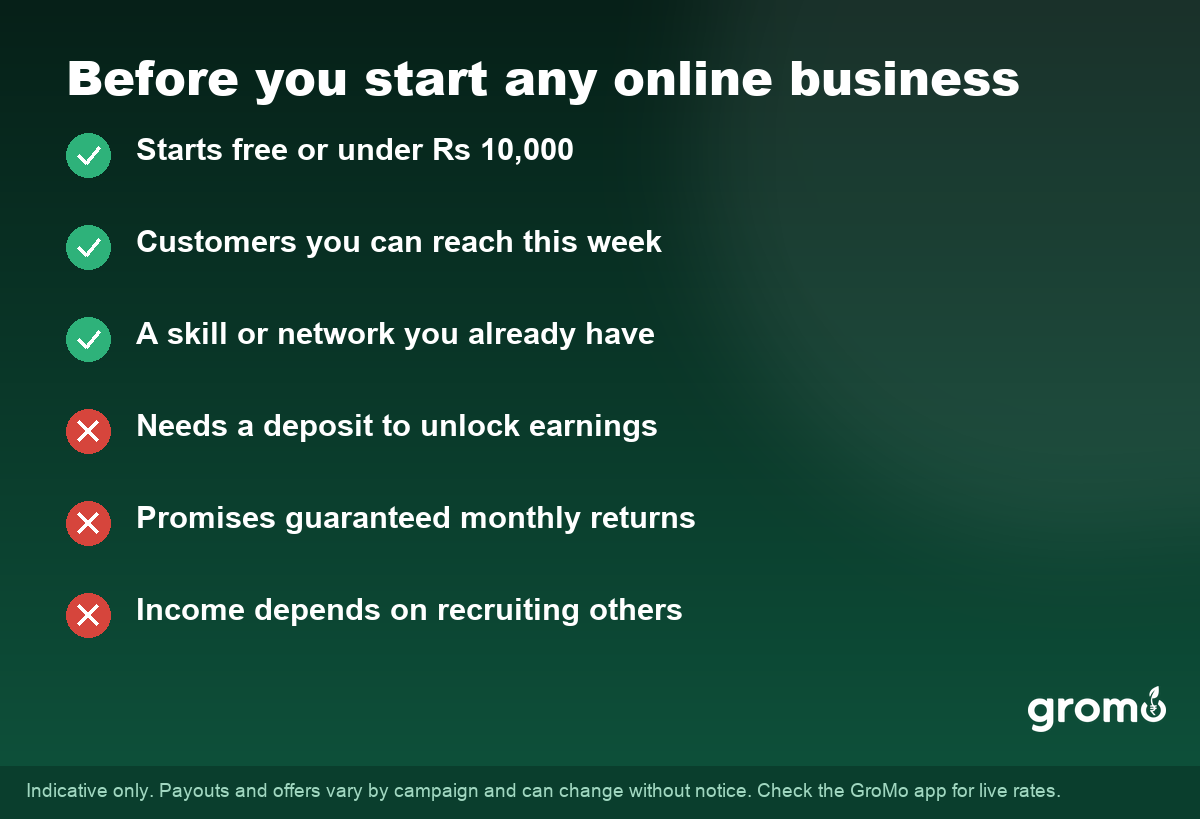
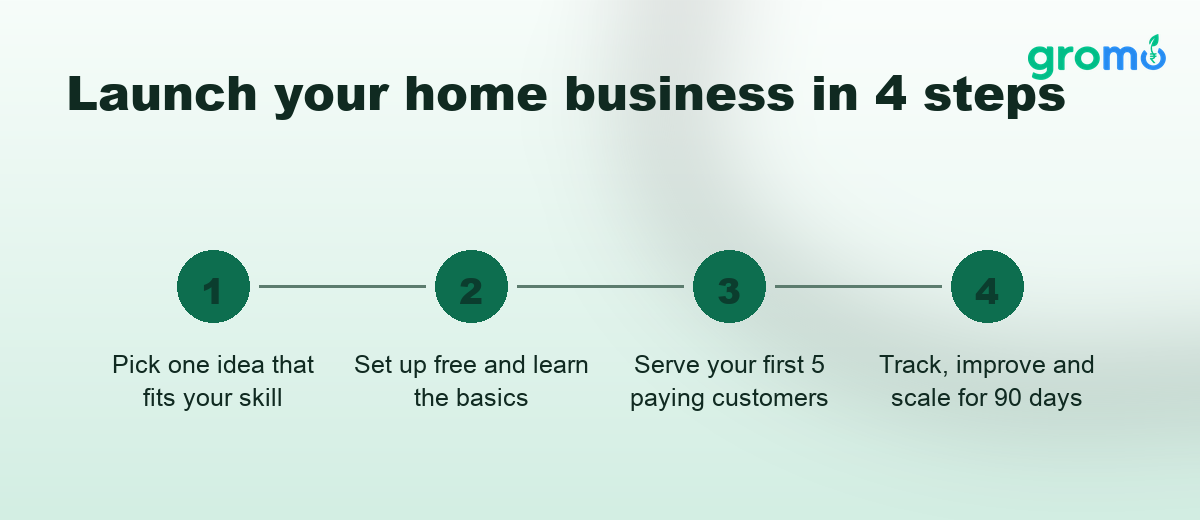
Whichever you choose, apply the owner's rule: one idea, ninety days, real customers, honest accounting. Avoid anything that asks you to deposit money to "unlock" earnings — a business earns from customers, not from you. And if you want the one model that combines zero investment, real training, and an income that grows with your reputation, start as a GroMo Partner and make your first sale from the network you already have.
FAQ: Online Business Ideas for Beginners
What is the best business idea for a beginner in India?
Selling financial products with GroMo is the strongest beginner business: it costs nothing to start, includes free training, pays commissions of Rs 5,000-50,000+ per month for consistent partners, and builds repeat customers — the person who takes one product through you returns for the next. Freelancing and tutoring are the best alternatives if you already have a teachable or sellable skill.
Which is the cheapest business to start from home?
GroMo, reselling, online tutoring, freelancing, and digital products all start at Rs 0 — your phone and time are the entire setup. Even the costliest ideas on this list, like a home food business, launch for Rs 2,000-10,000. If any 'business opportunity' asks for a large joining fee or deposit, it is not a business — walk away.
What are the best online business ideas from home for beginners?
The ten covered in this guide: financial product distribution with GroMo, reselling, freelance services, online tutoring, social media management, print-on-demand, digital products, affiliate marketing, a YouTube channel, and a home food business with online orders. Pick based on what you already have — a network suits GroMo and reselling; a skill suits freelancing and tutoring; patience suits content and digital products.
How much can a beginner earn from an online business in India?
Realistic first-year ranges: Rs 3,000-20,000 per month for reselling, Rs 5,000-40,000 for tutoring and freelancing, Rs 10,000-40,000 for a home food business, and Rs 5,000-50,000+ for GroMo partners who work their network consistently. Content businesses like YouTube start near zero and can exceed Rs 1,00,000 monthly after 1-2 years of consistency.
Do I need to register a company to start an online business?
Not to begin. Individual freelancing, tutoring, reselling, and GroMo partnership all work as an individual with a bank account and PAN; income is simply declared in your tax return. Register formally once revenue grows — and for food businesses, get the inexpensive FSSAI basic registration early since delivery platforms require it.
Disclaimer
Nothing here is a guarantee of income. All startup costs and earning figures are indicative estimates; actual results depend on your skill, network, consistency, and market demand, and platform terms change over time. GroMo commissions are set by the partner banks and financial institutions, vary by product and campaign, and are paid only on approved applications — check the live commission in the GroMo app before relying on any figure. GroMo is available only to users aged 18 and above.
Everything above is general information, not financial, legal, or tax advice. No legitimate business opportunity ever requires a deposit or fee to let you earn.


