
Top Part-Time Business Ideas in India 2026: Earn ₹20K-₹1L


Part-Time Business Ideas India 2026: Earn ₹20K-₹1L Monthly
Making ₹20,000 to ₹1 lakh a month on the side is realistic in India right now, and you don't have to quit your job to do it. Digital platforms, freelancing, and financial product sales offer consistent income with flexible hours. They usually need zero upfront cash and just 2-4 hours of your day.
This isn't a niche trend anymore. The part-time economy hit ₹2.3 trillion in 2026, fueled by smartphones and a culture that's waking up to side income. Whether you are a professional, a student, or managing a home, there are proven models that fit your life and build real wealth.
Why a Side Business Beats a Second Job in 2026
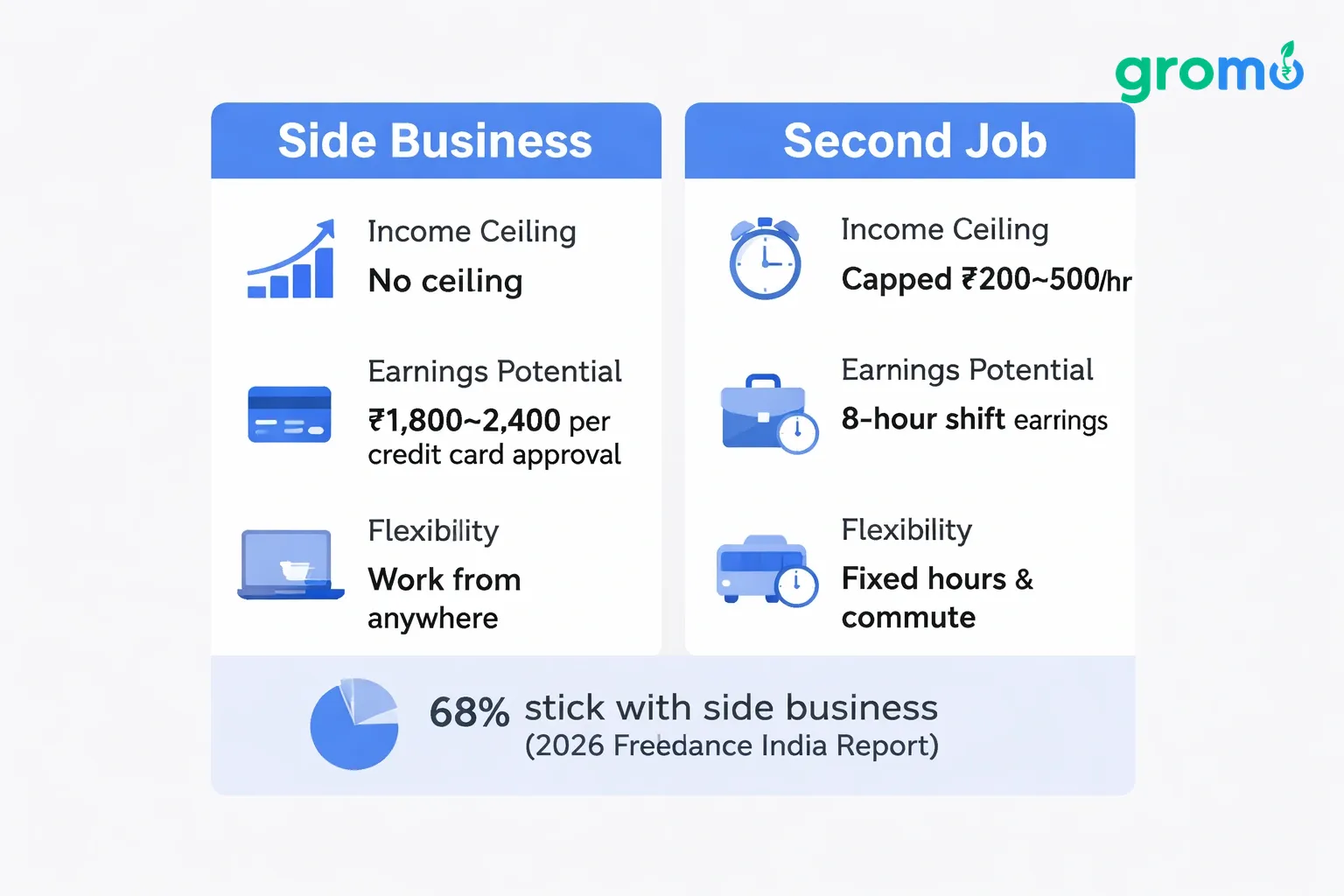
A side business in 2026 wins against a traditional second job because of the income ceiling. A job pays by the hour usually capped at ₹200-500. A business has no ceiling. If you sell financial products, a single credit card approval can pay ₹1,800-2,400. You'd have to work an 8-hour shift at a delivery job to make what a distributor makes in a few hours.
Look at the trade-offs. A part-time job demands fixed hours and a commute. A digital business runs from anywhere your couch, a coffee shop, or your lunch break. The 2026 Freelance India Report found that 68% of people stick with their side business for over two years, compared to just 34% who stay in gig economy jobs.
Then there's the tax angle. Business expenses internet, laptop depreciation, coworking spaces lower your taxable income under Section 44AD. If you have a side business, you can save ₹15,000-45,000 a year in taxes compared to earning the same amount from a second salary.
What makes part-time businesses sustainable long-term? It comes down to skills. Selling financial products teaches you sales, customer management, and fintech. These are skills worth ₹8-12 LPA in the corporate world. After a year, successful side-hustlers often go full-time or use their new business acumen to negotiate a raise at their day job.
Top 5 Part-Time Business Models for Indian Professionals in 2026
Financial Product Distribution via GroMo
Selling financial products through GroMo is one of the fastest ways to hit ₹30,000-₹1,00,000 a month. You earn commissions on credit cards, savings accounts, demat accounts, and loans. The platform handles the heavy lifting you share a link, the customer applies, and the bank processes the deal. You get paid ₹250-2,400 for every successful conversion.
This works because India is still underbanked. Only 32% of people have credit cards. Your existing network of friends, family, and colleagues is a goldmine you haven't tapped yet. A Bengaluru IT professional made ₹87,000 in March 2026 working just 90 minutes a day, mostly during his commute and on weekends.
Where the time goes:
- Finding customers: 20 minutes a day
- Sending recommendations on WhatsApp: 30 minutes a day
- Follow-ups and help: 40 minutes a day
- Learning the ropes: 2 hours a week
You can get up to speed in 7-10 days. GroMo Academy offers free courses on product features and handling customer questions. Unlike selling insurance or mutual funds, you don't need a license to sell credit cards or savings accounts.
You can also scale by building a team. If you refer other distributors, you earn ₹100-200 on their sales. A Chennai teacher built a team of 40 people in six months and now makes ₹35,000 passive income plus ₹55,000 from her own sales.
Check our guide on zero-investment business ideas for more details.
Digital Marketing Consulting for Local Businesses
Local businesses restaurants, clinics, shops are trying to get online, and most have no idea what they're doing. You can charge ₹3,000-5,000 to set up a Google Business profile, or ₹8,000-15,000 a month to manage their social media. Running ads can bring in ₹12,000-25,000 a month per client.
The opportunity is massive. India has 63 million MSMEs, and 78% lack digital skills. A CA in Pune runs a side practice serving 12 local businesses, earning ₹1.1 lakh a month working just 12 hours a week mostly evenings and Sundays.
How to package your services:
- Starter (₹5,000/month): Social posts and Google Business setup
- Growth (₹12,000/month): The above plus a weekly blog and basic ads
- Premium (₹25,000/month): Full service including video content
You don't need paid ads to get your first clients. Look at your immediate circle family shops, friend's startups. Offer a discount or the first month free. Once they see results in 30-45 days, they will stay.
Skills you need: Canva for design (takes 2 days to learn), Meta Business Suite (3 days), and basic Google Analytics (5 days). You can pick up the essentials in about two weeks of evening practice. No coding required. If you are in Delhi, look at local opportunities.
Content Creation and Freelance Writing
Writing pays. You can earn ₹1-4 per word for blogs, ₹2-6 for technical documentation, and ₹1,500-4,000 for video scripts. Indian writers on platforms like Upwork and Fiverr make ₹25,000-75,000 a month working 15-20 hours a week.
The industry has exploded 340% growth since 2022. Companies need case studies, apps need blog posts, and coaches need scripts. A Mumbai marketing manager writes for B2B SaaS companies on the side, pulling in ₹68,000 a month for 6-8 articles.
Building your portfolio:
- Week 1-2: Write 5 sample pieces in a niche you know (fintech, health, edtech).
- Week 3-4: Publish them on Medium or LinkedIn to show what you can do.
- Week 5-6: Email 20 potential clients with your samples.
- Week 7-8: Deliver your first paid work and ask for testimonials.
Start cheap to build a portfolio. Once you have a track record, raise your rates. Specialists in fields like blockchain or medicine can charge ₹3-6 per word.
Managing your time: Most writing happens early morning or late night. A weekend session can produce 3,000-4,000 words. A single 2,000-word blog at ₹2/word is ₹4,000 for a few hours of work.
Online Tutoring and Skill Training
Teaching online can bring in ₹30,000-₹1,20,000 a month. You can teach school subjects, professional skills, or hobbies. Platforms like Vedantu and Udemy let you earn through live classes (₹500-2,000/hour) or recorded courses (passive income).
What's in demand in 2026:
- School subjects: Math and Science for Classes 8-12 (₹600-1,200/hour)
- Exam prep: JEE, NEET, UPSC (₹800-2,000/hour)
- Professional skills: Data analysis, marketing, AI (₹1,000-2,500/hour)
- Languages: English, Spanish, German (₹500-1,000/hour)
A Hyderabad software engineer teaches Python on weekends, earning ₹45,000 a month from live classes plus passive income from recorded courses. He spent 40-60 hours making the course, but it has since enrolled 340 students at ₹999 each.
Platform comparison:
| Platform | Setup Fee | Commission | Best For |
|---|---|---|---|
| Unacademy Plus | Free | 30% | Competitive exams |
| Udemy | Free | 37% (organic) | Recorded courses |
| Your own website | ₹3,000-5,000 | 0% | Established tutors |
| Vedantu | Free | 30-40% | School subjects |
Start with your network. Announce your classes on WhatsApp and LinkedIn. A free demo class converts 40-60% of attendees.
See our guides for Punjab, West Bengal, and Hyderabad for regional specifics.
E-commerce Reselling and Dropshipping
Reselling involves buying products wholesale and selling them at a markup on Amazon, Meesho, or Instagram. Dropshipping lets you list products without buying inventory you take the order, the supplier ships it. Margins run 15-35%.
Hot categories in 2026:
- Mobile accessories: Cases and chargers (30-40% margins)
- Home organization: Storage and kitchen tools (25-35% margins)
- Personal care: Skincare and wellness (35-45% margins)
- Fashion accessories: Jewelry and bags (40-50% margins)
An HR professional in Jaipur runs an Instagram jewelry business, sourcing from local markets. She makes ₹1.06 lakh profit on ₹2.8 lakh revenue, working 90 minutes a day plus four hours on Sundays.
Getting started:
- Week 1: Research your niche (spend 10 hours checking competition and margins).
- Week 2: Find suppliers (visit markets or join supplier platforms).
- Week 3: Set up your channel (Instagram business or Amazon Seller).
- Week 4: List 20-30 products with decent photos.
- Week 5-6: Test with small ads (₹3,000-5,000 budget).
- Week 7+: Put 40% of profits back into inventory and ads.
Fees vary. Amazon takes 5-20% plus shipping. Meesho takes 5-15% but handles logistics. Instagram direct sales have no fees but you manage payments and shipping yourself.
Automation helps. Use Shopify (₹1,500/month) or WhatsApp Business API. A Chennai IT analyst automated 70% of her dropshipping workflow chatbots handle questions, emails confirm orders, suppliers ship. She spends 30 minutes a day checking in.
How Working Professionals Manage Part-Time Businesses Successfully
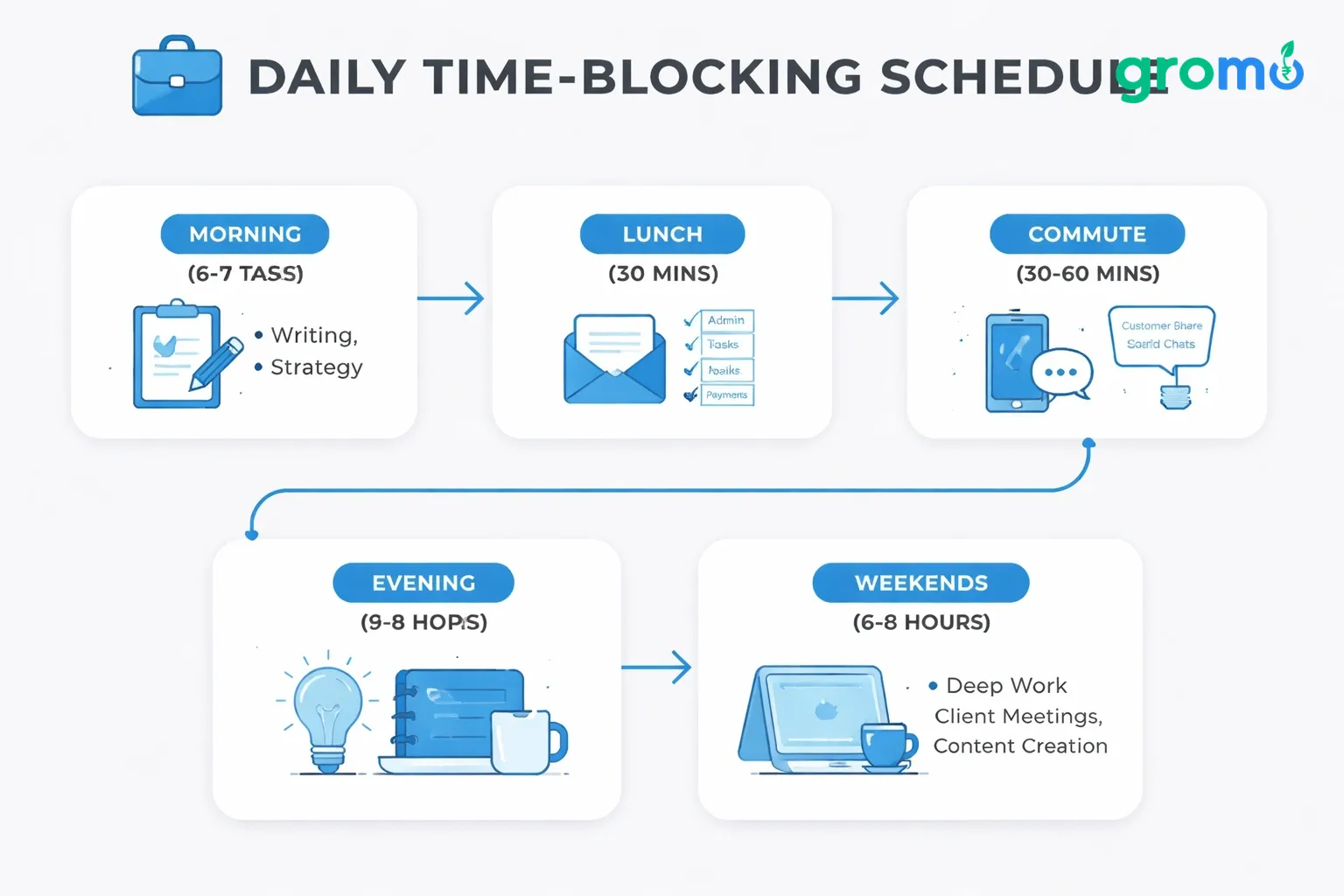
People who make over ₹50,000 a month from a side hustle usually follow three rules: time blocking, automation, and energy management. These keep you from burning out while keeping your boss happy.
Time blocking:
- Morning (6-7 AM): Hard tasks like writing or strategy.
- Lunch (30 mins): Admin like emails and payments.
- Commute (30-60 mins): Customer chats and social posts.
- Evening (9-10 PM): Learning and planning.
- Weekends (6-8 hours): Deep work client meetings, creating content.
A Delhi financial analyst making ₹92,000 from GroMo uses this pattern. He does customer engagement on his Metro commute, training on Saturday mornings, and strategy on Sunday afternoons.
Tools that save time:
- WhatsApp Business: Auto-replies save 45 minutes a day.
- Calendly: Scheduling links save 2 hours a week.
- Google Sheets + Zapier: Automatic tracking saves 3 hours a week.
- Buffer: Schedule social posts in one go.
Energy matters more than time. Do the hard stuff when you are sharp. For most people, that's morning. Save the boring admin for when you are tired.
Handling your employer: Be honest. If your business doesn't compete with your job or use company resources, most bosses won't care. The main thing to avoid is a "conflict of interest." Selling financial products to consumers usually doesn't conflict with a B2B job. Check your contract or ask HR if you are worried.
Taxes change when you earn over ₹50,000 a month on the side. Register as a sole proprietor and keep a separate bank account. Section 44AD lets you pay tax on 8% of your digital business turnover, which is simpler than detailing every expense.
We have region-specific guides for Mumbai, Bangalore, Gujarat, and Tamil Nadu.
Financial Product Distribution: The Highest ROI Part-Time Business for 2026
Selling financial products via GroMo gives you a 380% better return on your time than other side hustles. There's no inventory, digital approvals are instant, and you can earn from a team. To hit ₹1 lakh a month, you need 2-3 hours a day. To make the same in tutoring or writing, you'd need 20-25 hours a week.
Let's look at the math: A credit card approval pays ₹1,800-2,400. If you convert 3 people a day (which is realistic after a month of learning), that's ₹6,000 a day or ₹1.8 lakh a month. Even with a 60% failure rate, you just need to talk to 5 people a day to hit your targets.
Comparison:
| Business Model | Monthly Earning | Weekly Hours | Effective Hourly Rate |
|---|---|---|---|
| Financial distribution | ₹80,000 | 10-12 | ₹1,850-2,000 |
| Freelance writing | ₹60,000 | 18-20 | ₹750-830 |
| Online tutoring | ₹70,000 | 20-24 | ₹730-875 |
| Digital marketing | ₹90,000 | 12-15 | ₹1,500-1,875 |
| E-commerce reselling | ₹50,000 | 15-18 | ₹695-830 |
The real growth comes from building a team. Unlike tutoring or writing, where you are capped by your own hours, distribution scales through referrals. Recruiting 10 active sellers can add ₹15,000-25,000 passive income. A Mumbai professional followed this path: ₹35,000 in months 1-3, ₹68,000 in months 4-6 after recruiting 8 people, and ₹1.15 lakh by month 12 with a team of 25.
What to sell:
- Credit cards: Best payout (₹1,800-2,400). Target salaried people with good credit scores.
- Savings accounts: Fast approvals (₹200-600). Good for students.
- Demat accounts: Growing demand (₹250-400). Good for young professionals.
- Personal loans: High pay (2-5% of the amount). Good for people who need cash fast.
- Business loans: Biggest payouts (₹10,000-15,000). Good for shop owners.
Don't stick to just one product. A customer who takes a loan today might need a credit card next month. Over 18 months, a single customer can be worth ₹4,000-8,000 to you.
The regulatory edge: You don't need a license to sell credit cards or savings accounts. Selling insurance or mutual funds requires exams. This keeps the barrier to entry low. However, people who take the GroMo Academy courses convert 2.3x more customers than those who don't.
The platform does the heavy lifting. KYC, approvals, and payouts are automated. You focus on the customer. A Pune engineer calls it "running a bank branch without the rent or the headaches."
Watch out for reversals. If a customer defaults on the first few EMIs, you lose the commission. The fix is simple: sell the right product to the right person. Don't just chase volume. Top sellers keep 94-97% of their payouts because they match the product to the customer's actual needs.
Read our guide on earning ₹1 lakh monthly while working full-time for more.
Common Mistakes That Kill Part-Time Businesses (And How to Avoid Them)
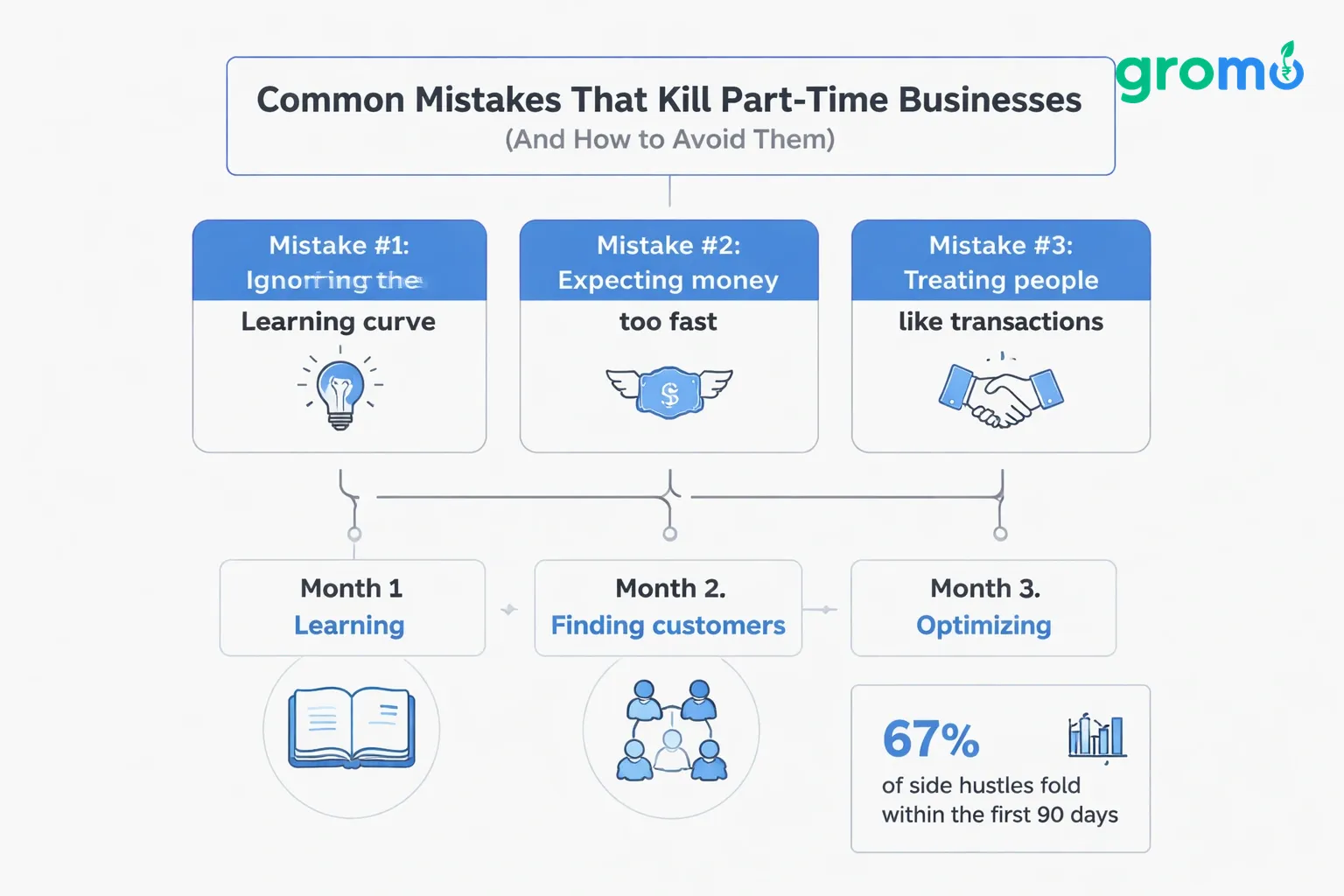
Most side hustles fail for three reasons: expecting money too fast, treating people like transactions, and scaling before the basics work. Looking at data from failed ventures in 2025-26, 67% folded within the first 90 days. These mistakes are preventable.
Mistake #1: Ignoring the learning curve
Newcomers expect a paycheck in week one and quit when they see ₹2,000. The reality is different. Month 1 is for learning. Month 2 is for finding customers. Month 3 is when you optimize. A Kolkata teacher made ₹4,500 in her first month, almost quit, but kept going. She made ₹28,000 in month 2 and ₹67,000 in month 3.
Solution: Set goals for actions, not rupees. Month 1: Finish training and find 20 leads. Month 2: Convert 10 people. Month 3: Hit ₹30,000-40,000. The money follows the effort.
Mistake #2: Being transactional
Failed distributors treat people like ATMs get the sale, disappear. Successful ones build relationships. They follow up, explain the fine print, and check in months later. A customer's lifetime value is ₹2,000 if you treat them once. It's ₹8,000-12,000 if you stay in touch over 18 months.
Solution: Keep notes. Use a basic CRM or even a notebook. Know your customer's goals. Set reminders to check in. A quarterly message like "Saw gold loan rates dropped, thought of you" makes you an advisor, not just a seller.
Mistake #3: Scaling too early
Some people spend ₹50,000 on inventory before selling a single item. Others record a 10-hour course before finding one student.
Solution: Test first. Sell 5 units before buying 50. Pre-sell your course to 3 people before recording it. A Chennai distributor proved he could sell 2 credit cards a day to his friends before he started recruiting a team.
Mistake #4: Being inconsistent
People work hard for 10 days, see little return, and stop for 20 days. Then they wonder why they lost momentum. Consistency builds reputation. 3 customers a week for 12 weeks is better than 20 customers in one week and then silence.
Solution: Set a non-negotiable minimum. Talk to 5 people daily. Write 2 posts a week. Teach 3 classes. These minimums take an hour or so and keep the business alive even during busy weeks.
Mistake #5: Stopping learning
Once they make some money, people stop trying new things. A distributor making ₹40,000 from credit cards might stick to that forever, ignoring business loans that pay ₹10,000 per sale.
Solution: Spend 10-15% of your time learning. Set monthly goals like "finish the loan certification" or "watch 3 sales videos." A Pune distributor grew from ₹25,000 to ₹1.2 lakh by constantly adding new products and skills.
For more on avoiding pitfalls, see our guides on remote jobs and making money online.
The Future of Part-Time Businesses in India: 2026-2030 Projections
India's part-time economy is on track to hit ₹6.8 trillion by 2030. AI is automating tasks, companies are accepting portfolio careers, and platforms are making it easier to start. NASSCOM projects that 42% of professionals will combine a job with a business by 2029.
What's changing:
- AI is lowering the bar: You don't need to be a designer to make a flyer anymore. Tools like ChatGPT and Midjourney do the heavy lifting. This makes it easier to start, but harder to stand out if you're mediocre.
- Faster finance: RBI's 2026 Account Aggregator framework is speeding things up. Loan approvals that took 48 hours now take 4. By 2028, they will be instant. This means you can sell more in less time.
- Moonlighting rules: The government is expected to clarify side-business rules soon. This will likely protect employees who work outside hours without competing with their employer.
- Fewer, better platforms: The 50+ apps you see today will consolidate into 10-15 major players. This is good for part-timers you can go deep on one platform instead of spreading yourself thin.
- Tax changes: A proposed "Micro-Business Tax Regime" could simplify filing for small earners, bringing more informal hustles into the formal economy.
New opportunities coming:
- AI consulting: Small businesses need help setting up AI tools. Potential: ₹15,000-30,000/month for a few hours of setup work.
- Sustainability compliance: New ESG rules mean companies need help tracking their carbon footprint.
- Senior care coordination: Helping families manage appointments and care for aging parents.
How to position yourself: Winners will have a niche skill, use a platform like GroMo or Udemy, and build an audience. By 2028, the top distributors will look like small advisory firms with systems and support staff, earning ₹3-5 lakh a month while generalists scrape by on ₹50,000.
If you are starting now, commit to an 18-month plan. Build skills in months 1-6. Optimize in months 7-12. Systematize in months 13-18. This puts you ahead when the market matures.
Compare your path with strategies from successful part-timers and those earning while working full-time.
Frequently Asked Questions
Q: Is ₹50,000-1,00,000 a month actually realistic while working full-time?
A: Yes, about 18-22% of people hit this within 6-12 months. The key is choosing high-ticket work like financial distribution (₹1,800+ per sale) instead of low-wage tasks. You need 10-15 hours a week for the first six months to build momentum. Case studies show 3 out of 5 GroMo distributors who stay consistent for 90 days cross the ₹50,000 mark by month 4.
Q: How much money do I need to start?
A: For financial distribution, content creation, or freelancing, the cost is basically zero just your phone and data. For e-commerce or tutoring, you might need ₹5,000-15,000 for tools or inventory. GroMo specifically requires no capital. You earn commission without buying stock or renting an office.
Q: Do I need to register my business?
A: You only need GST registration if your annual turnover exceeds ₹20 lakhs. Below that, it's optional. If you are making ₹50,000-1,00,000 a month, you can register as a sole proprietor (costs ~₹2,000-3,000) to make tax filing cleaner and claim expenses. Many people wait 6-8 months to see if the business sticks before registering.
Q: Will my employer find out? Can they stop me?
A: They might find out via social media or tax filings. Legally, most contracts only ban "conflicts of interest" or using company resources. If you sell financial products to consumers while working a B2B job, and you do it on your own time and phone, it's usually fine. Check your employment contract's "moonlighting" clause. Some companies like TCS and Wipro now allow non-competing side hustles.
Q: How do I avoid burnout?
A: Set strict boundaries. Don't touch the side business during office hours. Do high-focus work when you have the most energy. Automate what you can auto-replies, scheduling tools, payment links. Successful people usually work 2 hours on weekdays and a longer block on weekends, keeping one day completely free for rest.
Q: How long until I hit ₹1 lakh a month?
A: For high-commission work like financial distribution, top performers (top 15%) get there in 6-9 months. The timeline usually looks like this: ₹5,000-15,000 in month 1-2 (learning), ₹25,000-40,000 in month 3-4 (improving), ₹50,000-70,000 in month 5-7 (scaling), and ₹80,000-1,20,000 by month 8-12. Building a team is the fastest way to push past the ₹80,000 ceiling that solo operators hit.


