
Loans for Low Credit Scores in India 2026: Options & Tips


A low credit score doesn't lock you out of borrowing in India — it just narrows the list of lenders who will say yes, and raises what you'll pay for the money you get. If your CIBIL score is under 650, you still have real, RBI-regulated options in 2026: small-ticket NBFC loans, income-based fintech lenders, and secured borrowing against gold or fixed deposits. This guide covers where to look, what it actually costs, and how to use a loan to rebuild your score instead of digging a deeper hole.
What's Changed for Low Credit Score Borrowers in 2026
Lending to low-score borrowers keeps shifting as NBFCs recalibrate risk models and RBI keeps tightening digital lending rules. A few things worth knowing right now: more lenders are weighing bank-statement cash flow and app-based income signals alongside your CIBIL number rather than rejecting on score alone, RBI's stricter digital lending norms have pushed a number of unregistered apps out of the app stores, and secured options like loans against FD remain the cheapest fallback when unsecured lenders keep saying no. The core strategy hasn't changed — borrow small, repay perfectly, rebuild.
What Counts as a Low Credit Score in India?
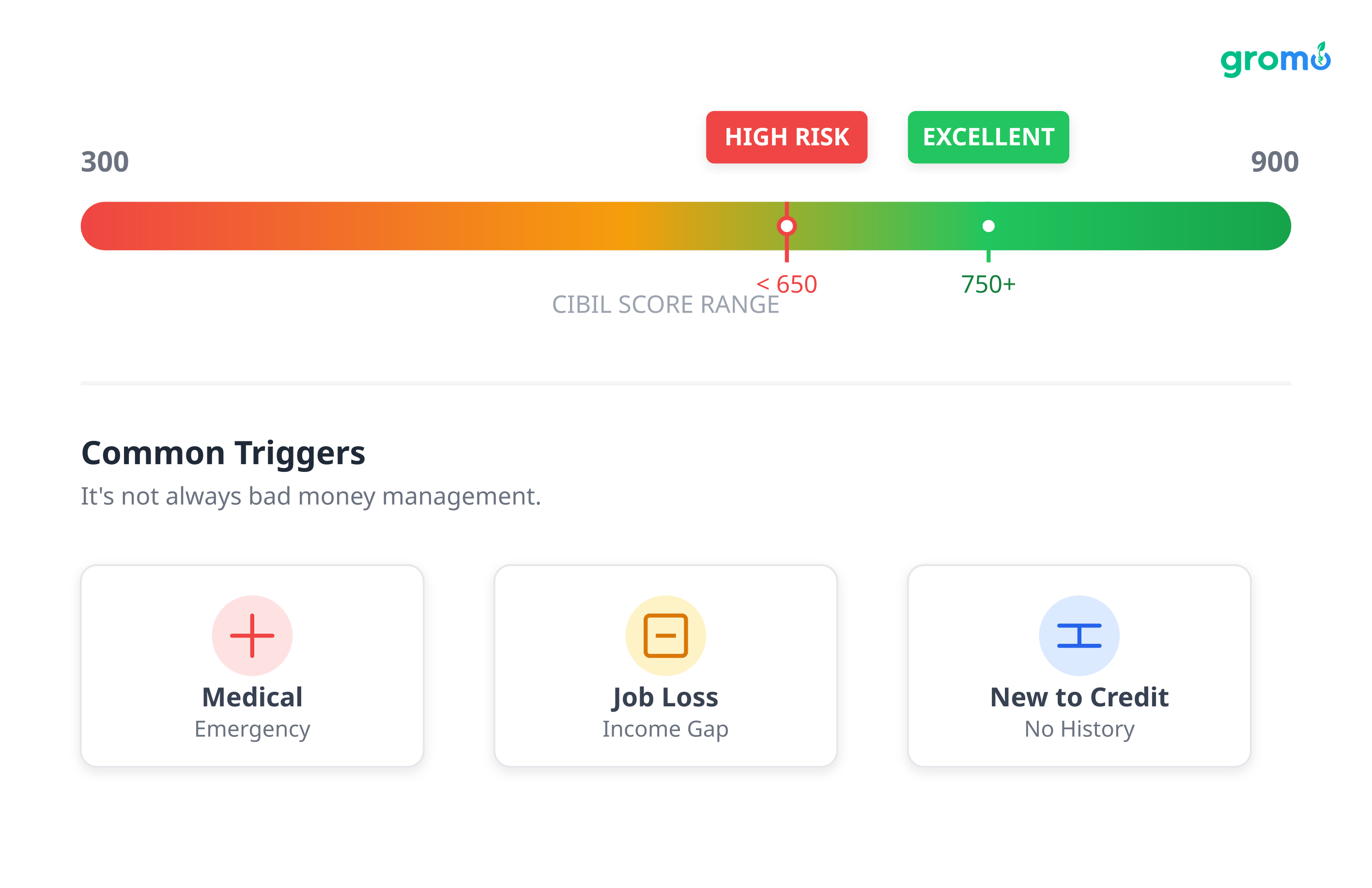
Think of your credit score as a financial report card. In India, CIBIL scores run from 300 to 900. Lenders love 750+. Anything below 650 gets stamped "high risk," and below 600 most mainstream banks won't even process the application.
This doesn't mean you're bad with money. A medical emergency, a job loss, or simply being new to credit can knock your score down fast. If your specific issue is a poor CIBIL history rather than no history at all, our dedicated guide on loans for bad CIBIL scores walks through that scenario in more depth.
Why Do Credit Scores Drop?
Usually, it's one of these:
Late payments. Missing an EMI hurts. A single 30-day delay can shave off 50-80 points.
High utilization. If you're using more than 70% of your credit card limit, lenders get nervous. An ₹80,000 balance on a ₹1 lakh limit is a red flag.
Too many applications. Every time you apply for credit, there's a "hard inquiry." Four to seven of those in six months makes you look desperate for money.
Thin history. Being new to credit means you have no track record. Lenders hate guessing, so a thin file can score almost as poorly as a bad one.
Settlements. Settling a debt for less than you owe stays on your report for years and signals to future lenders that you couldn't repay in full.
Where Can I Get a Loan With a Low Credit Score in 2026?
Fintech has changed the game. You won't get prime rates, but you can get money. RBI-regulated NBFCs increasingly look at your current income and repayment behaviour rather than only your past score.
Small Loans (₹5,000 – ₹30,000)
| Lender | Loan range | What they check | Notable feature |
|---|---|---|---|
| PaapaPay | ₹500 – ₹20,000 | PAN, Aadhaar, current income | Disbursal in around 10 minutes |
| My Money Bazaar | Up to ₹30,000 | Basic KYC, income | Lenient scoring criteria, minimal paperwork |
| Smartcoin | Up to ₹1 lakh | Income/bank statements | Works with self-employed borrowers without salary slips |
Mid-Range Loans (₹50,000 – ₹2,50,000)
| Lender | Loan range | What they check | Notable feature |
|---|---|---|---|
| Tez Credit | Up to ₹2,50,000 | Minimum salary of roughly ₹18,000, PAN, Aadhaar, salary proof | Coverage across thousands of pincodes |
| Ram Fincorp | ₹50,000+ | Video KYC | No foreclosure charges, disbursal within 24 hours |
| Moneyview | ₹50,000 – ₹2,50,000 | Score and income | Known for approving borrowers in the 600–700 range |
Always confirm any lender's current terms and NBFC registration directly on their app or website before applying — rates and eligibility criteria change without notice.
The Cost of Borrowing With a Low Score
Let's be honest: these loans are expensive. A borrower with a 780 score might get an interest rate in the low double digits. A 600 score usually means something closer to 18-24%. Lenders charge more because they're taking on more risk.
To survive this without making things worse:
Borrow the minimum, not the maximum you qualify for.
Pick the shortest tenure you can realistically handle.
Never miss a payment — one slip can undo months of progress.
Read the fine print. Processing fees and penal charges add up fast.
Can You Get a Loan With No Credit History or No Income Proof?
Yes — a thin or missing credit file is not the same problem as a bad one, and lenders treat it differently. If you've simply never taken credit before, some NBFCs will still lend based on bank statements, employment type, or a guarantor, rather than a CIBIL score that doesn't exist yet. Our guide on getting loans without a credit score covers which lenders accept first-time borrowers and what they ask for instead.
If you have income but no formal salary slips — freelancers, gig workers, small business owners — the fix is different again. Several fintech lenders now approve based on bank statement cash flow rather than payslips. That's covered in detail in our post on personal loans without income proof.
When Unsecured Loans Aren't an Option
If even the flexible lenders say no, secured loans are your next move.
Loans against FD: Borrow against your Fixed Deposit. The rate is low, typically 1-2% above your FD's own rate, and your credit score barely matters because the deposit secures the loan.
Gold loans: The classic fallback. You get liquidity fast, usually a large share of the gold's value, without a hard credit check.
Peer-to-peer lending: P2P platforms match you with individual lenders willing to accept higher risk for a better return.
How Do I Know a Lender Is Safe? (Avoiding Loan Sharks)
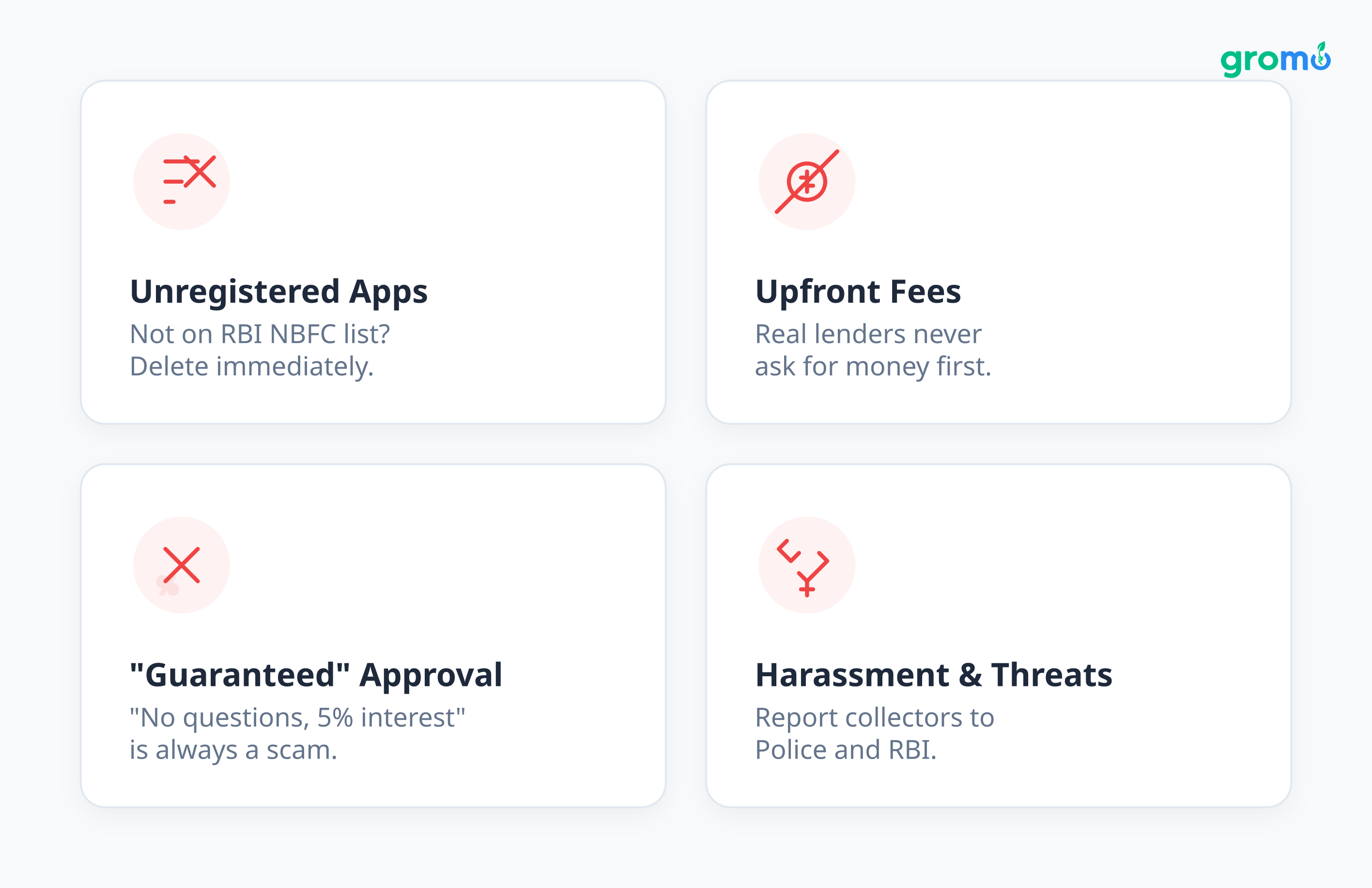
Desperate borrowers get targeted, so verify before you apply anywhere. Avoid these traps:
Unregistered apps: Check the RBI's NBFC list before installing anything. If the app isn't there, delete it. Our post on how to identify RBI-registered loan apps walks through the exact steps to verify a lender.
Upfront fees: Real lenders don't ask for money before giving you a loan.
"Guaranteed" approvals: "No questions asked, low interest" claims are a scam. Real lenders verify everything, every time.
Threats: If collectors harass you or contact your family, report them to the police and to the RBI.
We've written a full guide on RBI-approved loan apps to help you sort the legitimate ones from the predators.
How Do I Use a Loan to Fix My Credit Score?
Don't just take the money — use it to rebuild trust with lenders.
Borrow small. Take ₹50,000 even if you qualify for ₹2 lakh. It's easier to manage.
Automate. Set up auto-debit so you never miss an EMI.
Lower utilization. Get your credit card balance below 30% of the limit.
Stop applying. Avoid new credit applications for at least 3-6 months.
Check your report. Errors happen. Dispute them immediately.
For the step-by-step version with timelines, our post on how to improve your credit score breaks it down further.
Can I Earn Extra Income While I Repair My Credit?
Here's a thought: while you're fixing your credit, why not build more income at the same time? More income means faster repayment, but if you're already working full-time, "get a second job" isn't practical advice. That's where selling financial products on the side comes in.
GroMo lets you earn commissions by helping people you know apply for credit cards, loans, and savings accounts — from your phone, on your own schedule, with no investment needed. You're already learning about loans to fix your own situation; that knowledge is worth something. If a friend or relative needs a credit card or a savings account, refer them and get paid for it.
The math is straightforward:
Credit card referrals: roughly ₹500-₹1,700 per approval.
Personal loan referrals: roughly 0.5%-3.5% of the loan amount.
Demat/savings accounts: roughly ₹100-₹1,400 per account.
Help 10 people get a credit card in a month and that's an extra ₹5,000-₹17,000 you can put straight into your EMI. We break down the numbers in our guide on earning ₹10K-₹1L monthly.
How Much Can You Actually Earn Referring Loans and Cards?
GroMo partners have collectively earned over ₹100 crores in payouts. They aren't finance professionals — they're students, homemakers, and shop owners who figured out how to share the right links with the right people.
Personal loans: Several lenders pay commissions in the 3%+ range of the disbursed amount.
Credit cards: Payouts commonly range from a few hundred rupees to a couple of thousand per approved card, depending on the issuer.
Help someone secure a ₹2 lakh personal loan and a 3.5% payout works out to ₹7,000 — that's not pocket money, that's a meaningful chunk of your own debt cleared. Check current, exact payout rates inside the GroMo app before relying on any figure, since brand payouts change over time.
A 12-Month Recovery Blueprint
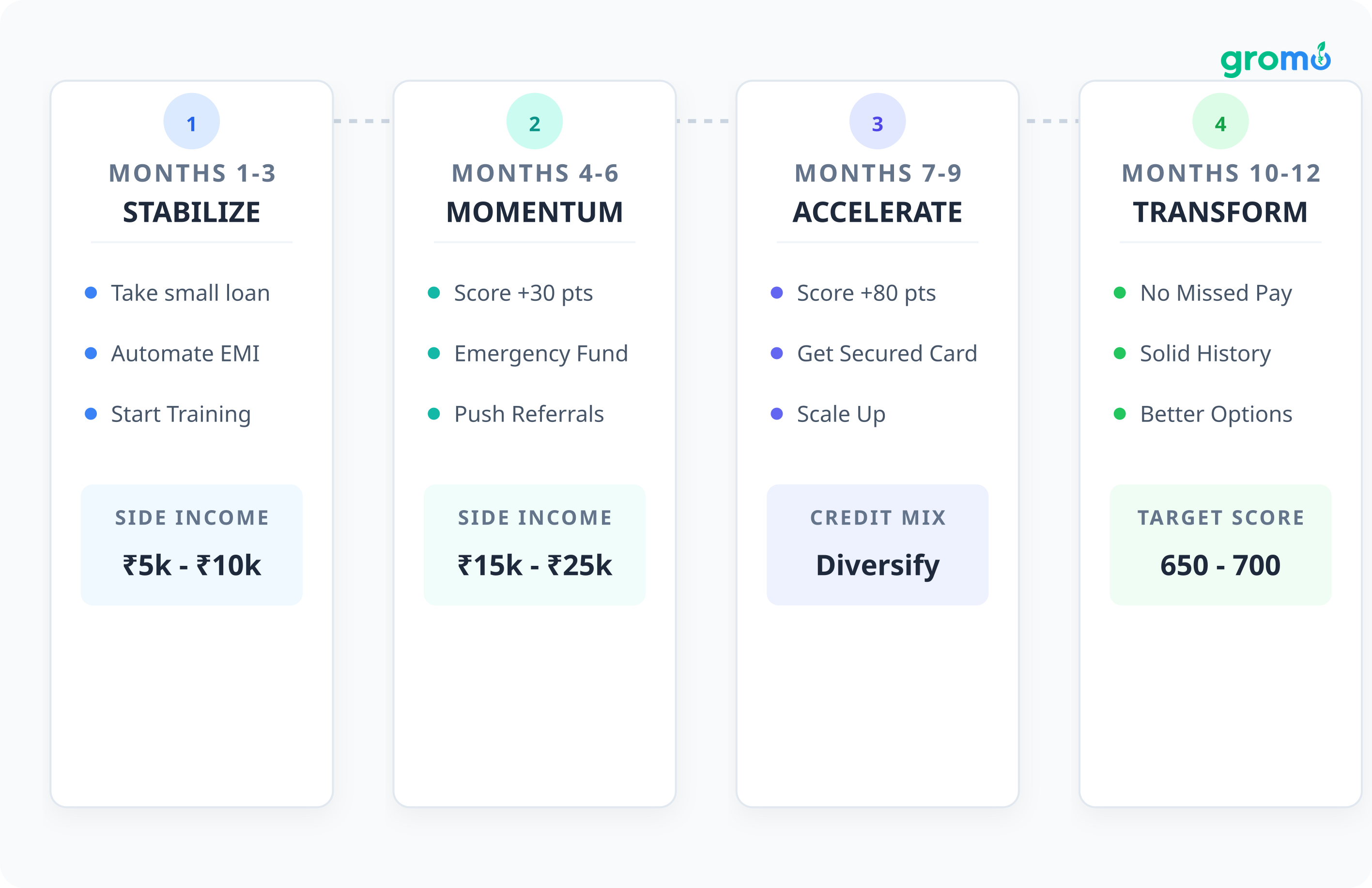
Months 1-3: Stabilize.
Take a small loan only if you must. Automate the EMI. Start building a side income. Target a modest, steady monthly amount rather than chasing a big number immediately.
Months 4-6: Build momentum.
Your score should start nudging up. Push your side income higher and build a small emergency fund so a bad week doesn't mean a missed payment.
Months 7-9: Accelerate.
Consistent, on-time repayment usually produces a noticeable score jump by this point. Consider a secured credit card to show you can handle different types of credit responsibly. Scale up referral income if you've started one.
Months 10-12: Transform.
If you haven't missed a payment, you should be well clear of the sub-600 range and qualifying for meaningfully better rates. Your side income, if you built one, should feel real rather than incidental.
The Mental Game of Rebuilding Credit
Bad credit feels shameful. It feels like a permanent mark. It isn't. Plenty of people climb out of a sub-500 score by simply not missing payments for a stretch of months. The stress fades once you see the numbers moving in the right direction instead of guessing at them.
For more on generating extra cash flow alongside a full-time job, check our piece on making money online in India.
What Comes After Fixing Your Score?
Fixing your credit is step one. The end goal is financial stability, not just a higher number:
Multiple income streams, so one bad month doesn't derail everything.
6-12 months of expenses saved as a buffer.
Using credit for leverage, not survival.
It's possible. The tools are there. You just have to start. Our guide on zero-investment business models has more ideas if you want to diversify your income beyond referrals.
FAQs
Can I get a personal loan with a credit score of 600 in India?
Yes. Several NBFCs work with this range, prioritising current income and bank statement cash flow over past history. Expect interest in the 18-24% range and smaller loan amounts than a prime borrower would get.
Can I get a loan with a CIBIL score of 550 or lower?
It's harder but not impossible. Focus on secured options like a loan against FD or gold, or micro-loan NBFCs that lend on current income. Rates will be higher and amounts smaller until your score recovers.
Is there a way to get a loan without any credit score at all?
Yes. First-time borrowers with no CIBIL file can often get approved based on bank statements, employment type, or a guarantor. See our guide on loans without a credit score for the specific lenders that work this way.
How long does it take to go from 600 to 750?
Budget roughly 6-9 months to cross 700, and another 6-12 months to reach 750, assuming perfect payments and low credit utilization throughout.
Are small-ticket loan apps safe?
Only if they're RBI-registered NBFCs. Verify the license number on the lender's own site. If an app asks for upfront fees or access to your contacts, uninstall it and move on.
Does referral income count as proof of income for a loan application?
Yes. Consistent monthly deposits in your bank statement help demonstrate income stability, which many lenders now weigh alongside your credit score.
What's the fastest way to gain points on a low score?
Pay down credit cards to under 30% utilization immediately, automate every payment, stop applying for new credit for a few months, and dispute any errors on your credit report.
Should I take a loan just to build credit, or wait it out?
If you genuinely need funds, take a small loan and repay it perfectly — active, positive payment history builds a score faster than doing nothing at all. Don't borrow purely to "build credit" if you don't need the money.
Can students or homemakers with no income history get a loan?
Some NBFCs and secured-loan options (like loans against FD) don't require a salary slip, which makes them accessible to students and homemakers. Building a small side income, such as referral earnings, can also help strengthen future applications.


